About Phelsuma grandis Gray, 1870
Taxonomic Classification
Phelsuma grandis Gray, 1870 is a species of day gecko.
Adult Size
Adults reach a total length of 9–11 inches (23–28 cm), and females are generally smaller than males.
Base Body Color
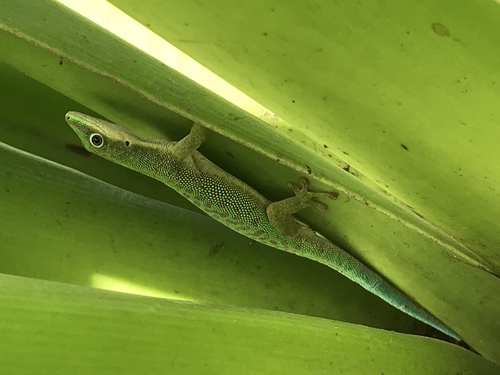
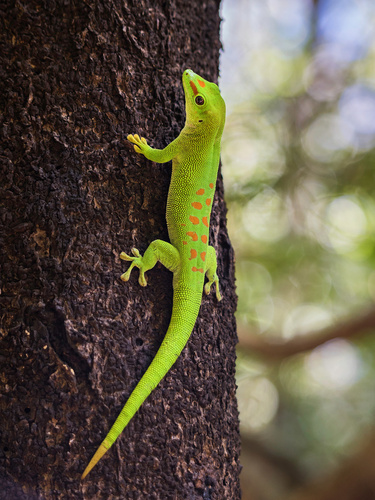
The gecko's body is typically bright green, and rarely bluish green.
Dorsal and Facial Markings
A red stripe always runs from the nostril to the eye; the back usually has red dots or bars that are highly variable, and may be completely absent in some individuals. Some specimens may also have small blue spots.
Adult Morphological Feature
Adult individuals have large calcium storage sacs on their necks.
Juvenile Markings
Juvenile Phelsuma grandis typically have far more red markings than adults; many of these red markings fade as the gecko ages, leaving only the permanent markings that will remain for the rest of its life.
Underside Color
The gecko's underside ranges from creamy white to pale yellow.
Stress Color Change
When the lizard is stressed, its color darkens to an overall dark green, and its red facial and back markings turn orange.
Native Distribution
This species is naturally widely distributed across northern and northwestern Madagascar.
Introduced Range Overview
Introduced populations have been recorded in Florida, Hawaii, Reunion Island, and Mauritius. It was introduced to Reunion Island in the mid-1990s.
Distribution in Mauritius
In Mauritius, it was first found mainly in the northern part of the island, then in Floreal and upper Plaine Wilhems, and has since spread enough to be considered a threat to native biodiversity.
Ecological Impact in Mauritius
In Mauritius, this day gecko encroaches on the habitats of four native Phelsuma species: Phelsuma cepediana (the blue-tailed day gecko), Phelsuma guimbeaui (the lowland forest day gecko), Phelsuma ornata (the ornate day gecko), and Phelsuma rosagularis (the upland forest day gecko).
Breeding Period
The species' breeding season runs from December to June. During this period, females can lay multiple pairs of eggs.
Incubation and Hatching
Hatchlings emerge after approximately 48 to 80 days, with incubation time depending on temperature.