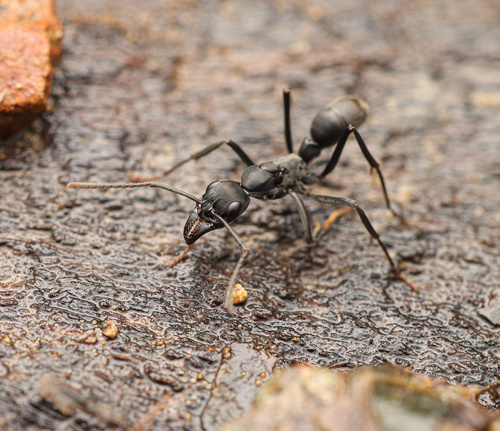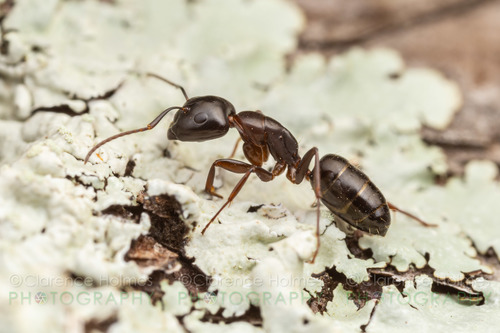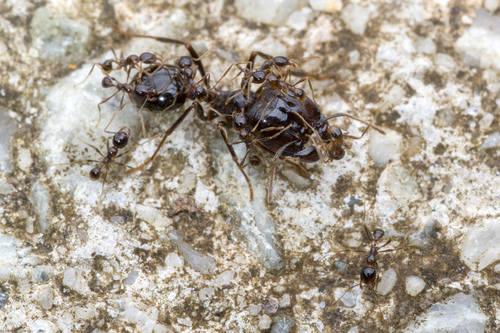
About Pheidologeton diversus (Jerdon, 1851)
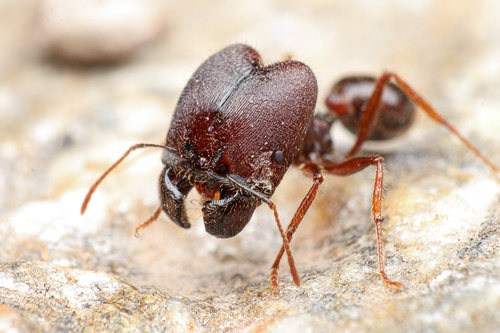
Formerly known as Pheidologeton diversus (Jerdon, 1851), Carebara diversa is a eusocial insect. Its individuals display continuous allometric variation in size and morphology, which supports task allocation and work partitioning. Minor workers measure between 1.3 and 2.5 mm in length, while major workers are far larger. Many intermediate size forms exist between the smallest minor workers and the largest major workers. The heads of the largest workers are approximately 12 times the size of the heads of the smallest workers, and the dry weight of a large major worker is approximately 550 times that of the smallest workers. These size-linked morphological differences align with the species' division of labor. For example, small young minor workers specialize in caring for larvae, and expand their activities as they age. Minor workers have bodies ranging from yellowish brown to reddish brown. Each of their mandibles has five teeth, and their antennal scapes are short, not extending past the posterior margin of the head. When viewed from the front in full face view, minor workers have rectangular heads with weakly convex posterior margins. Major workers have bodies ranging from reddish brown to blackish brown. Their heads are proportionately larger, almost square, and have a convex posterior margin when viewed from the front. The mandibles of major workers are large and triangular, with a sharp apical tooth, and their masticatory margins have no distinct teeth. Their eyes are relatively small, and their antennal scapes are half as long as their heads. Carebara diversa has a wide distribution, ranging from India through Southeast Asia to Taiwan and the Philippines. Field records of the species occurring in Japan are limited; it has only been found at two very southern points: Okinawa Island and Chicchi-jima Island. Specimens collected at the Camp Zama U.S. Air Force base in Kanagawa Prefecture are thought to have been introduced commercially from Southeast Asia.