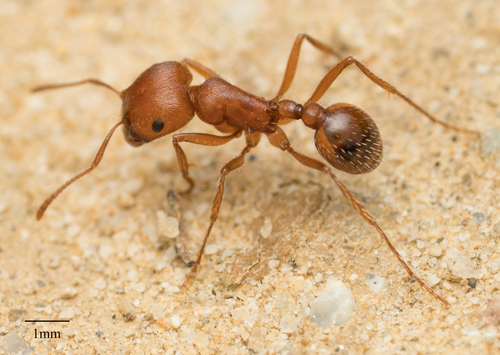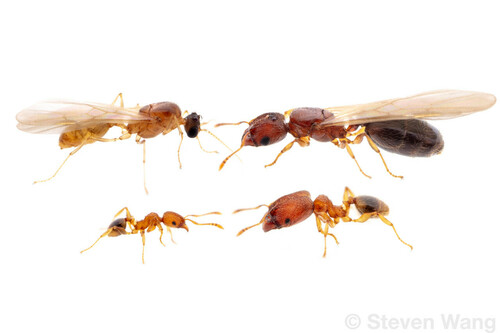
About Pheidole parva Mayr, 1865
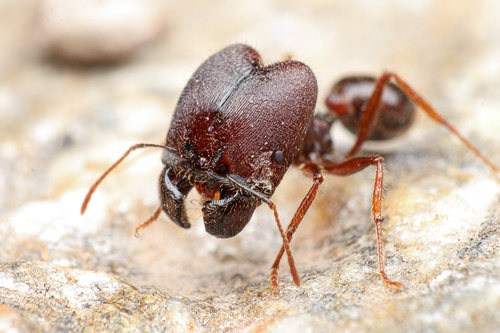
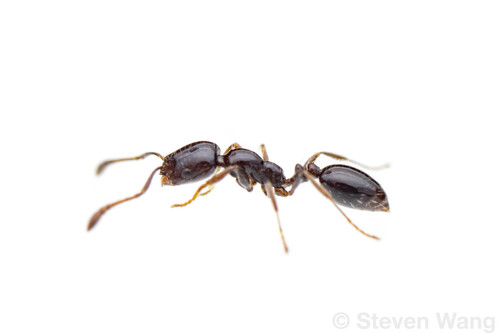
On smaller islands of the Southwest Indian Ocean, Pheidole parva can be superficially confused with Pheidole jonas, especially because the minor workers of the two species have relatively similar morphology. Three key features distinguish both worker castes of these two species. First, the two species differ in the relative length of the postpetiole across both castes. Second, the worker scapes of P. parva are distinctly shorter than those of P. jonas. Third, the heads of major workers of P. parva are distinctly longer than wide, while P. jonas major worker heads are on average as long as wide.
Pheidole parva is a widespread, probably invasive species in parts of the Old World, and a member of the P. rinae species complex. It is most likely an introduced species to the Malagasy region. Live P. parva ants have recently been found traveling on different ships. The species is ubiquitous across many different habitats and microhabitats on Mauritius and the Seychelles, and is present in ports on these islands, which indicates it is well-adapted to human environments. This makes it a likely candidate to invade new areas via human commerce.
This tiny, relatively inconspicuous ant is very common in its occupied ranges. It can be found in soil and leaf litter, under stones or root mats, and inside rotten logs. It forages on or nests in the ground, and also occurs in lower vegetation and even under the bark of live trees. It has been collected in a wide variety of habitat types, including parks, gardens, mangrove, coastal scrub, degraded dry forest, littoral forest, mixed forest, and rainforest, at elevations ranging from 1 to 445 m. It has also been recorded on the Arabian Peninsula, in Saudi Arabia and the United Arab Emirates, where it was collected on farms mostly inland from the coast at elevations of 675 and 735 m. Since its nests have been found under potted plants, P. parva was very likely introduced to the Arabian Peninsula through human commerce.