About Pheidole megacephala (Fabricius, 1793)
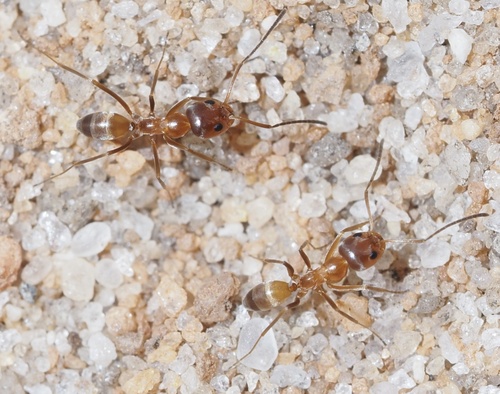
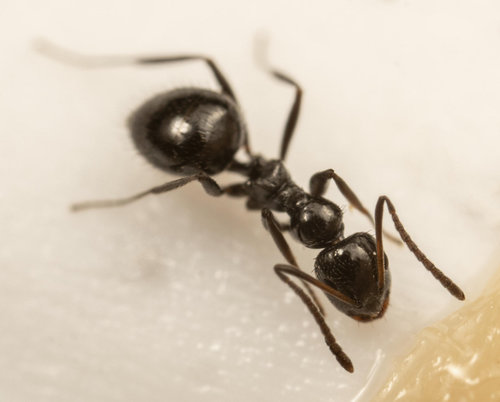
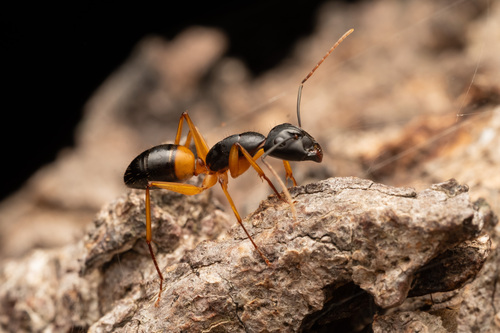
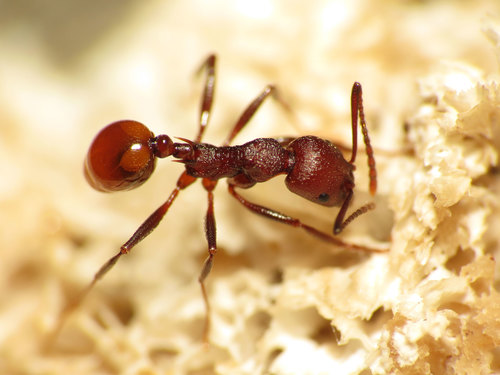
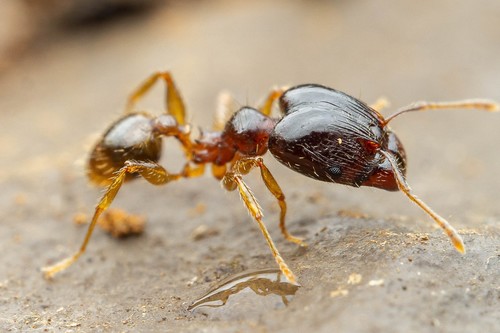
This species of ant, Pheidole megacephala, has two distinct castes of worker ants: major workers and minor workers. Its common name, bigheaded ant, comes from the disproportionately large head of the major worker. Unlike soldier castes in other ant species, major workers of this species are not primarily responsible for colony defence. They have thick, powerful mandibles that they use to crush seeds and cut larger food pieces into smaller portions, which the smaller, more numerous minor workers then carry back to the nest. Major workers reach approximately four millimetres in length, which is twice the length of minor workers. Both castes vary in colour, ranging from yellowish-brown or reddish-brown to nearly black. The rear half of the ant's head is smooth and glossy, while the front half has a sculptured texture. Antennae are twelve-segmented, curved, and end in club-like tips. The waist, also called the petiole, is two-segmented, with the node directly behind the first segment being conspicuously swollen. A pair of short, upward-facing spines is present on the waist. Sparse, long hairs cover the ant's body. Pheidole megacephala was first formally described in 1793 by entomologist Johan Christian Fabricius, from a specimen collected on the island of Mauritius. An earlier 1775 record of this species exists from Egypt, where it was named Formica edax. Regardless of its confirmed African origin, bigheaded ants have since spread to many tropical and subtropical regions across the globe. Bigheaded ants form underground nesting colonies. Colonies can contain multiple queens, and supercolonies form through a process called budding: a queen and a group of workers leave the original nest to establish a new nearby colony, without the swarming behaviour seen in other ant species. In Florida, nuptial flights of winged reproductives occur during winter and spring. After these flights, fertilized queens shed their wings and locate a suitable site to found a new colony, where they begin laying eggs. Each queen can lay up to 290 eggs per month. Eggs hatch between two and four weeks after being laid, producing legless white larvae that are fed by worker ants. Larvae pupate approximately one month after hatching. Adult workers emerge 10 to 20 days after pupation. Minor workers are far more numerous than major workers. Foraging trails extend up tree trunks, along branches, and into tree canopies. On the ground surface, the ants build debris-covered foraging tunnels with multiple entrances; these structures are often mistaken for similar tubes constructed by subterranean termites. Pheidole megacephala is also capable of living indoors.