About Phedimus spurius (M.Bieb.) 't Hart
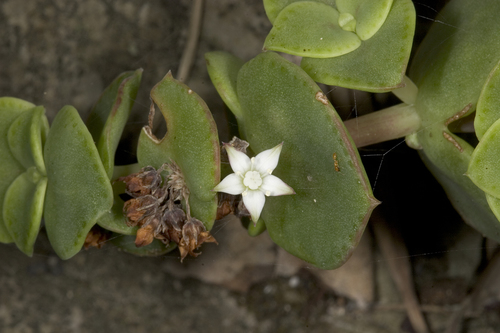
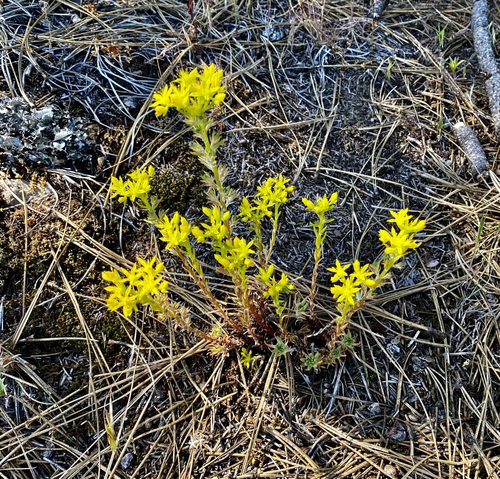
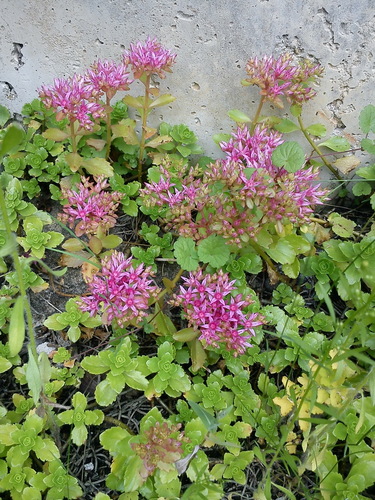
Phedimus spurius, commonly called two-row stonecrop, is a stonecrop species with numerous sprawling or creeping stems that often root as they grow. These smooth or slightly bumpy stems are typically 5 to 15 centimeters long. Its leaves are usually arranged in opposite pairs, though they occasionally alternate; leaves attach directly to the stem or have very short stalks, and grow in two distinct rows along stems. Leaf shape varies from spoon-like to rounded or oblong, with a wedge-shaped base and small rounded teeth along the upper edges. Leaves measure 15–35 mm long and 10–12 mm wide. They are succulent, medium green with red-tinged edges. Older lower stem leaves are deciduous, while newer leaves near stem tips are evergreen; these upper leaves deepen to a rich burgundy in autumn and persist through winter. Flowering stems, which can sprawl or grow at an angle, reach 10–30 cm, have a rough texture, and are reddish in color. Flowers are densely clustered in flat-topped groups called corymbs, each holding 15–30 blooms. The small leaf-like bracts beneath the flowers are narrow and elongated. Flowers usually have five petals (occasionally six), and sit on very short stalks or are nearly stalkless. Sepals are triangular and pointed, sometimes slightly rough near the tip, and grow up to 10 mm long. Petals are upright at the base and spread toward the top, often with slightly curled tips and a central ridge. They measure 7–12 mm, and range in color from pure white to deep crimson. The flower’s stamens are 5–9 mm long, with red pollen-producing structures. This species flowers from late spring to mid-summer, and attracts butterflies. The small four-sided nectar glands measure approximately 0.5 × 1 mm. The fruit is made up of five upright, smooth 5–9 mm long seed capsules joined at the base. Phedimus spurius shows considerable variation in leaf shape, size, and flower color. In the northeastern portion of its native range, white-flowered forms (once described as Sedum involucratum and S. oppositifolium) are more common, while red-flowered forms dominate in the west. Despite these differences, genetic studies indicate all forms belong to a single uniform species. In early growth stages, P. spurius can resemble P. hybridus or P. ellacombianum, but differences become clear at flowering: the latter two species bear yellow blossoms, while P. spurius does not. White-flowered varieties of P. spurius are generally less floriferous, but all forms spread vigorously, with tangled stems extending beyond 30 cm over time, a growth habit uncommon in related species. The type specimen of Phedimus spurius was collected in Georgia. The species is native to Georgia, northern Iran, and northeastern Turkey, where it grows on cool rocky sites and in subalpine meadows at elevations from 1,250 to 3,000 meters. Phedimus spurius has become naturalized across many parts of Europe, especially in disturbed habitats including walls, rocky areas, roadsides, refuse sites, and waste ground. It frequently escapes cultivation, most likely via garden waste disposal or bird dispersal, and can form persistent colonies once established. Horticulturist Ray Stephenson has described Phedimus spurius as "perhaps ... the most common stonecrop in cultivation". It grows best in well-drained, acidic to neutral soils with dry to moderate moisture, and prefers full sun, though it can tolerate some light shade. It grows well in sandy or gravelly soil, adapts to nutrient-poor conditions, and requires proper drainage to remain healthy. It is highly drought-resistant and should not be overwatered. Pests and diseases rarely affect it, though snails, slugs, and scale insects may occasionally appear. Phedimus spurius is commonly planted in rock gardens, as small-scale ground cover, and at border fronts; it also thrives in stone wall crevices, on sunny slopes, and along edges. Due to its vigorous spreading habit, it is unsuitable for small rock gardens but works very well as a fast-growing ground cover. It can outcompete more delicate species and requires active management. It does not grow well in containers, as it needs ample space to spread. It may also be used for green roofs. It spreads easily by rooting at nodes that touch the ground, and can be propagated effortlessly through cuttings or division. Dark-leaved and variegated forms grow more slowly, making them valuable for adding contrast to borders. Numerous cultivars of Phedimus spurius have been developed, though many lack distinct distinguishing traits. Leaf color correlates with flower shade: plants with the greenest foliage tend to produce the palest blooms, while plants with wine-red, copper, or deep purple leaves produce progressively darker flowers. The typical form has pink-purple flowers and green foliage that develops a reddish hue in full sun. Cultivars vary in color intensity from pale to dark. 'Coccineum' (synonym 'Splendens') is a cultivar with redder flowers and reddish-tinged foliage that has been cultivated for over a century. 'Album' (synonym Sedum oppositifolium) is a white-flowered form with consistently green foliage, but is reluctant to bloom. 'Green Mantle' (synonym 'Album Superbum') is similar to 'Album' but more floriferous, with white blooms that fade to pale pink. 'Salmoneum' is a North American selection with flowers that are slightly more salmon-toned than the typical species. 'Schorbuser Blut' ('Dragon's Blood'), a slow-growing yet highly sought-after form, starts the growing season with bright green, red-edged leaves that darken by autumn. It has received the Royal Horticultural Society's Award of Garden Merit. 'Roseum' is an older variety nearly identical to the species. 'Erd Blut' produces purple flowers with more deeply colored foliage. 'Bronze Carpet' is a North American form with bronzed leaves and slightly deeper-colored flowers. 'Fulda Glut' is notably darker than the typical species. It also has reddish leaves but produces striking scarlet flowers. Sedum spurium 'Voodoo' has leaves heavily tinged with dark red and deep reddish-pink flowers. 'Ruby Mantle' features deep red foliage and purple blooms. 'Red Carpet' stands out with its bronze foliage and bright red blossoms. 'Purpurteppich' ('Purple Carpet'), true to its name, bears purple flowers and large springtime leaves that emerge brown-violet. 'Tricolor' is known by this name in North America, while in Europe it is sold as Sedum spurium var. variegatum. Its leaves display a striking mix of green, creamy-white, and wine-red. Its leaf shape differs from the parent species, leading to occasional misidentification as S. kamtschaticum var. variegatum. However, S. kamtschaticum var. variegatum has a more upright growth habit and yellow flowers, whereas 'Tricolor' produces light pink-purple blooms. Reversion to solid green foliage is common. Sedum spurium var. involucratum is rare in cultivation, identifiable by its exceptionally large sepals that are nearly as long as the petals. It is a small, light-petaled form with chromosome counts of 2n = 28 and 42.