About Phaseolus vulgaris L.
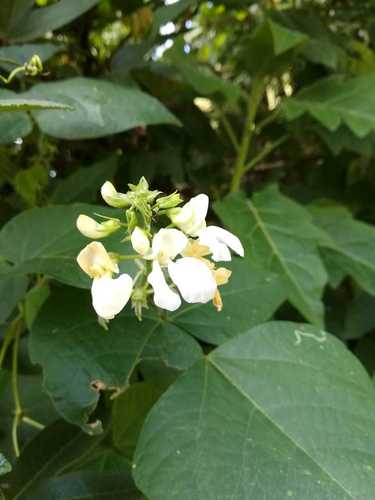
Phaseolus vulgaris L., commonly known as common bean, has two main cultivated growth forms: bush varieties grow as erect bushes 20 to 60 centimeters (8 to 20 inches) tall, while pole or running varieties grow as vines 2 to 3 meters (7 to 10 feet) long. All wild members of this species naturally have a climbing growth habit. All varieties produce alternate leaves that are green or purple, divided into three oval, smooth-edged leaflets. Each leaflet measures 6 to 15 cm (2 to 6 in) long and 3 to 11 cm (1 to 4 in) wide. The flowers are white, pink, or purple, roughly 1 centimeter long, and each holds 10 stamens. These flowers are self-pollinating, which makes it easier to select stable cultivated varieties. After flowering, the plant develops pods 8 to 20 cm (3 to 8 in) long and 1 to 1.5 cm wide. Pods can be green, yellow, black, or purple, and each contains 4 to 8 beans. Some varieties grow a fibrous string along the pod edge; these stringed varieties are generally grown for dry beans, because green stringy beans are not considered commercially desirable. The beans themselves are smooth, plump, kidney-shaped, and grow up to 1.5 cm long. They come in a very wide range of colors, and are often mottled with two or more different colors. Beans of this species retain their ability to germinate for up to five years. Like most species in the Phaseolus genus, the genome of P. vulgaris has 11 chromosomal pairs (2n = 22). Its genome is one of the smallest in the legume family, with a size of 625 Mbp per haploid genome. Raw or undercooked beans of this species contain a toxic protein called phytohaemagglutinin. Wild P. vulgaris is native to the Americas. It was domesticated independently in Mesoamerica and the southern Andes region around 8000 years ago, which gives domesticated common beans two distinct gene pools. Beans, squash, and maize (corn) are the three Mesoamerican crops that make up the "Three Sisters", a system central to indigenous American agriculture. Common beans were brought to Europe as part of the Columbian exchange, and are now grown on every continent except Antarctica. Like most members of the legume family Fabaceae, common beans get the nitrogen they need through an association with rhizobia, which are nitrogen-fixing bacteria. The toxic compound phytohaemagglutinin, a lectin, is present in many common bean varieties, and is especially concentrated in red kidney beans. White kidney beans contain around one third as much phytohaemagglutinin as red kidney beans, while broad beans (Vicia faba) contain only 5 to 10% of the amount found in red kidney beans. Phytohaemagglutinin can be inactivated through a two-step preparation process. The United States Food and Drug Administration recommends first soaking dry beans in water for at least five hours, then discarding the soaking water; this step is primarily used to reduce levels of indigestible carbohydrates. Next, the hydrated, softened beans must be boiled for 30 minutes to ensure they reach a high enough temperature for long enough to completely destroy the toxin. Poisoning outbreaks have been linked to cooking kidney beans in slow cookers at 80 °C (176 °F), a temperature that is not high enough to deactivate all of the toxin. The main symptoms of phytohaemagglutinin poisoning are nausea, vomiting, and diarrhea. Symptoms begin 1 to 3 hours after eating improperly prepared beans, and typically resolve within a few hours. Eating as few as four or five raw, soaked kidney beans is enough to cause symptoms. Canned red kidney beans are safe to use immediately, because they have already been cooked during processing. Beans are high in purines, which are metabolized into uric acid. Uric acid is not a toxin, but it may promote the development or worsening of gout. However, more recent research has questioned this association, finding that moderate intake of purine-rich foods is not linked to an increased risk of gout. Under favorable irrigated conditions, good commercial yields are 5 to 7 tonnes per hectare (2 to 3 short tons per acre) for fresh beans, and 1.4 to 1.8 tonnes per hectare (0.6 to 0.8 short tons per acre) for dry seed. Beyond food use, bean leaves have been used to trap bedbugs inside houses; microscopic hairs called trichomes on the leaves trap the insects. Since ancient times, beans have been used as tools in various divination methods, and fortune-telling that uses beans is called favomancy. P. vulgaris has been found to bio-accumulate zinc, manganese, and iron, and has some tolerance to the toxic effects of these heavy metals. This suggests it may be suitable for natural bioremediation of heavy-metal-contaminated soils.