About Phaneroptera nana Fieber, 1853
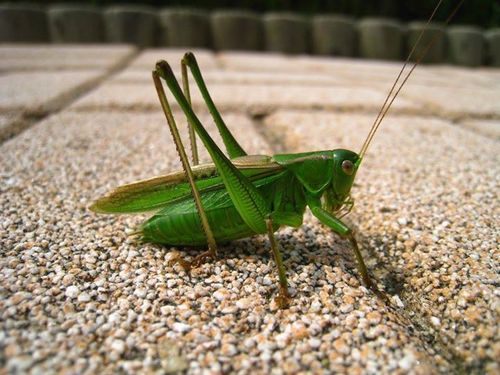
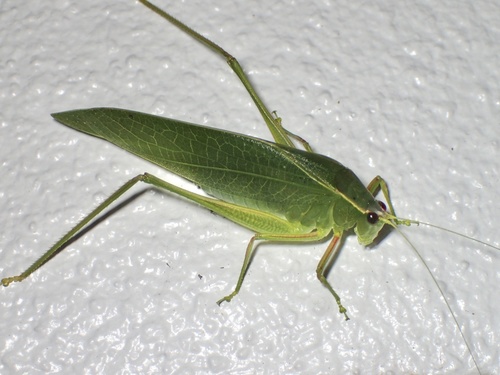
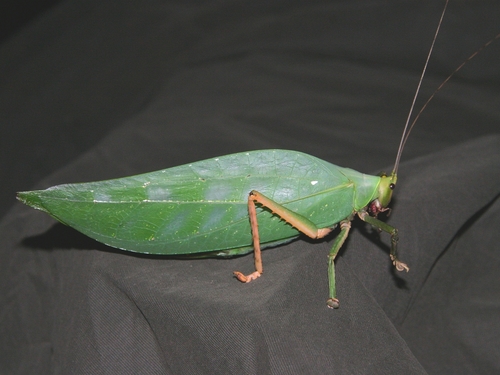
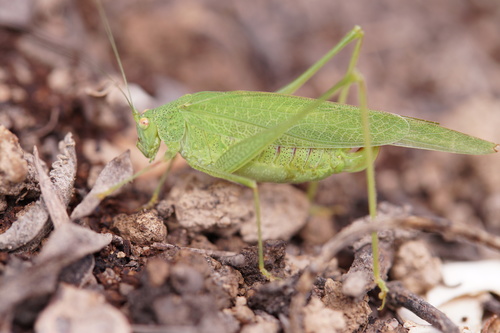
Phaneroptera nana, commonly called the Mediterranean katydid, has distinct size differences between adult sexes: adult males reach 13–15 millimeters (0.51–0.59 inches) in length, while adult females grow to 15–18 millimeters (0.59–0.71 inches). Both sexes have a basic light green body coloration covered in many small black spots, with bright orange eyes. Some individuals have a brown dorsal stripe along where the forewings (tegmina) meet, but this stripe never extends onto the pronotum. The hindwings are longer than the tegmina, with tegmina measuring approximately three-fourths the length of the hindwings; in some specimens, tegmina reach the apex of the posterior femurs. Adult males have prominent, curved cerci, while adult females have a sickle-shaped ovipositor that is about 5 millimeters (0.20 inches) long. Phaneroptera nana is similar in appearance to Phaneroptera falcata, and the two species are often confused in regions of Europe and other areas where their ranges overlap. They can be distinguished by features of the male subgenital plate and pronotum: in P. nana, the male subgenital plate tapers near the end of the body, while in P. falcata it diverges into two lobes. The pronotum of P. nana is narrower than it is tall, while the pronotum of P. falcata has roughly equal width and length, or is longer than it is tall. This bush cricket is native to mainland Europe, the Near East, and North Africa. The Indo-Malayan species Phaneropera subcarinata, described by Bolívar, is morphologically similar to P. nana, and was classified under the P. nana name by Carl Brunner von Wattenwyl. As an invasive species, P. nana has spread to the San Francisco Bay Area and may be widespread in the Los Angeles Basin, with records of its presence in California dating to at least 1952. It has also been recorded in Portland, Oregon since 2015 and in South America, and the Annals of Carnegie Museum hypothesizes it spread via shipping. It primarily inhabits sunny, dry habitats, especially shrubs and the low branches of trees. A unique reproductive behavior occurs in this species: female Mediterranean katydids sing in response to males, which prompts males to move toward the calling female. This reverses the typical katydid mating movement pattern, where females usually move toward calling males. Because females remain stationary while males locate them, females face lower risk of encountering threats and predators. Males will only interact with a female if she responds within 60 milliseconds, which ensures the female is close enough. Females are selective about which males they respond to, and generally prefer males that produce longer chirps. Females require at least two chirps from a male before they will respond and engage in a mating duet, but additional chirps beyond two do not increase the likelihood that females will duet. Female P. nana lay their eggs in the leaf lamina of plants. To do this, they bend their abdomen and chew an opening in the lamina. The eggs average around 3 millimeters in size. Eggs usually hatch in summertime, though hatching timing can vary. This hatching schedule means P. nana is most easily encountered during the summer and fall seasons.