About Phallus rubicundus (Bosc) Fr.
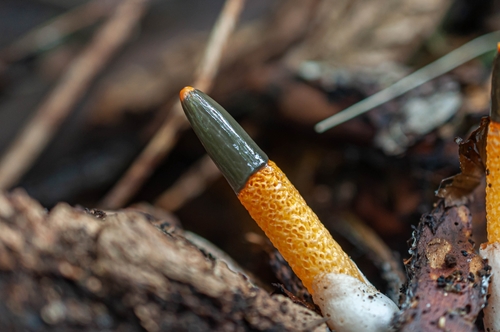
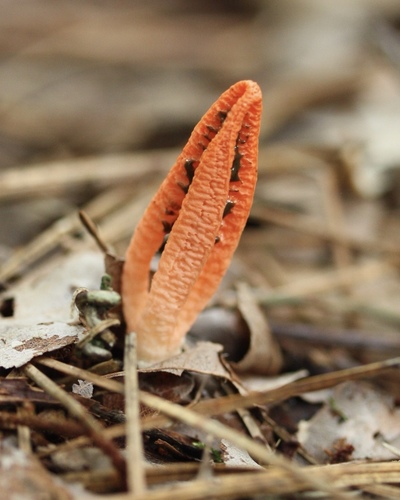
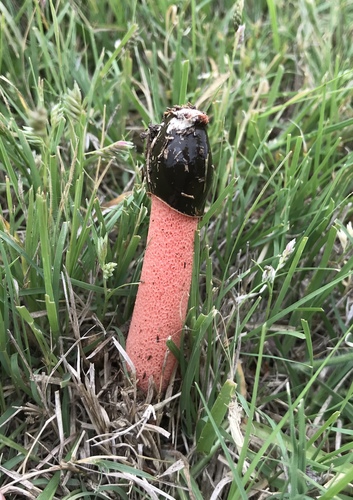
Immature (unopened) fruit bodies of Phallus rubicundus are spherical to egg-shaped, whitish, and measure 2–3 cm (0.8–1.2 in) long by 1–3 cm (0.4–1.2 in) wide. They grow singly or in groups of two to six eggs formed from a common mycelium, and are attached to their growing substrate by a cordlike rhizomorph. After expanding, mature fruit bodies reach up to 15 cm (5.9 in) tall. They consist of a hollow cylindrical stalk that supports a conical to bell-shaped cap. The orange to scarlet stalk tapers toward the top, and has a pitted surface. The wrinkled cap is scarlet red, measuring 2–3 cm (0.8–1.2 in) high by 1–2 cm (0.4–0.8 in) wide. It is initially covered with a foetid, slimy grayish-olive spore-bearing gleba. The remains of the immature egg case stay at the base of the stalk as a volva. The spores of Phallus rubicundus are smooth, elliptical, and measure 3.6–4.2 by 1.6–2.0 μm. Phallus rubicundus is often confused with the similar species Mutinus elegans. Unlike Phallus rubicundus, Mutinus elegans does not have a clearly separated cap, and instead carries its gleba on the apex of its pointed stalk.
Phallus rubicundus is a saprobic fungus. It grows in sandy soils, lawns, gardens, and yards, especially areas that are well-manured or amended with wood mulch. It is widely distributed across southern and eastern United States, including Hawaii, and may have been spread to these areas through the use of imported wood mulch for landscaping. In Australia, it grows mainly in tropical and subtropical regions, in areas with rotten wood or mulch. In Asia, it has been recorded in China, Japan, Korea, India, and Thailand. In Africa, it has been found in Ghana, Nigeria, Congo, Kenya, and South Africa. It is also known to occur in South America (Argentina and Brazil) and the Caribbean. This fungus was featured on a Sierra Leonean postage stamp in 1993.
In the Indian state of Madhya Pradesh, Phallus rubicundus is known locally as jhiri pihiri. Two indigenous forest tribes, the Bharia and the Baiga, use it as a treatment for typhoid. The Baiga also use it to treat labour pain. The fungus is prepared by grinding and mixing with sugar-cake, and one teaspoon of the preparation is given three times daily. Aboriginal Australians have been reported to use this fungus as an aphrodisiac. One study noted that mosquitoes, which are attracted to the smell of the fungus's gleba, die after consuming it. This means the fungus may warrant further investigation as a potential biological mosquito control agent.