About Phallus ravenelii Berk. & M.A.Curtis
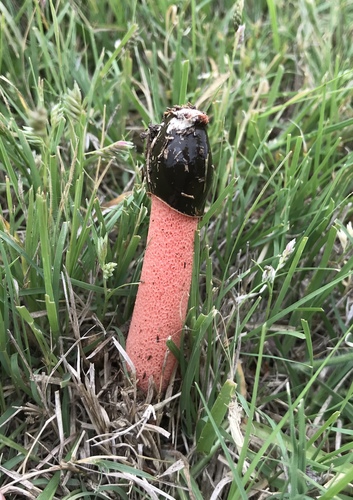
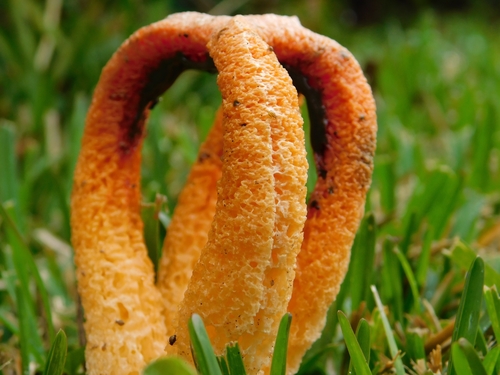
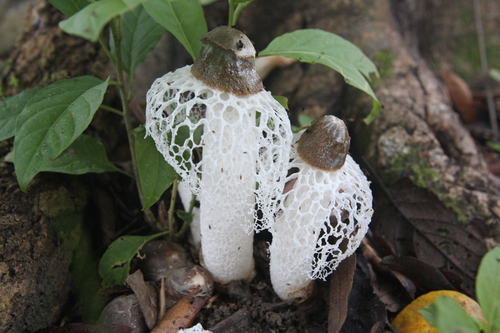
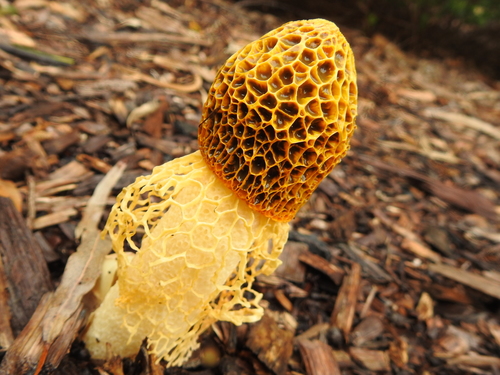
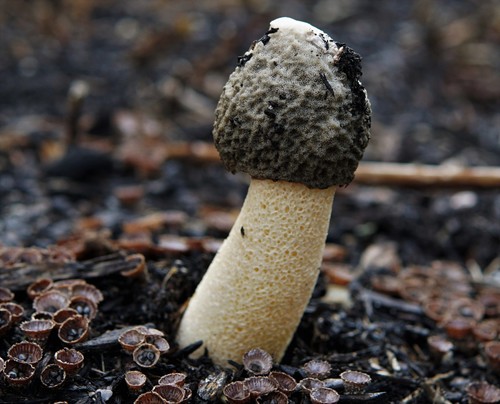
This mushroom, Phallus ravenelii, starts its development as pink-, lilac-, or purple-tinged "eggs" that resemble puffballs. The egg expands rapidly to form a phallus-shaped structure with a yellowish-white stalk and a thimble-like cap. The cap measures 1.5 to 4 cm (0.6 to 1.6 in) wide and 3 to 4.5 cm (1.2 to 1.8 in) tall, and the entire mature fruit body can reach 20 cm (7.9 in) in height. The cap has a finely granular texture, and is attached to a white open circlet at its top where it meets the stalk. In some specimens, this opening is relatively large with a broad margin, which gives the mushroom a truncated appearance. Microscopically, the cap surface is made of minute cells and cavities, with a spongy structure similar to the stem, but with smaller perforations than the stem. The lower margin of the cap is not attached to the stalk, and there is sometimes a membranous veil suspended like a collar around the stem under the cap; this veil can vary in length. This veil can already be seen in dissected unexpanded eggs, where it appears as a distinct thin layer of membranous tissue between the stalk and the cap before expansion. In this immature form, the veil is continuous from its connection to primordial tissue at the base of the stalk and the volva below, all the way to the tip of the stem where the stem joins the cap. The veil produced by P. ravenelii is distinct from the flaring, net-like indusium produced by Phallus species such as P. indusiatus. Gleba covers the cap; it is olive-green to dark brown in color, slimy in texture, and has a foul odor. The spores are 3 to 4.5 μm by 1 to 2 μm, colorless, elliptical in shape, and smooth in texture. They have thin walls and are covered with a thin, hyaline (transparent), sticky coating. The stalk is hollow, measures 10 to 15 cm (3.9 to 5.9 in) tall and 1.5 to 3 cm (0.6 to 1.2 in) thick, and ranges in color from slightly yellowish to white. There is usually a white to pink sac-like cup called a volva at the base of the stalk. When immature, the entire fruit body is enclosed within the volva as a skin-like tissue layer called a peridium, which ruptures as the mushroom emerges. The volva attaches to the growing substrate with whitish or pinkish rhizomorphs, which are thick, cord-like strands of mycelia. Rhizomorphs and mycelia exposed to air eventually turn whitish, while those that are freshly exposed from their substrate usually quickly turn bluish purple. The fungus produces watery, fleshy sclerotia that range from 1 to 10 mm thick and can reach up to 30 mm in length. The sclerotia are irregularly convoluted and lobed, and become hard and horny when dried. Sclerotia have the same color reaction to air exposure as rhizomorphs, and after long exposure to air, they gradually turn a uniform dark reddish brown. Phallus ravenelii is considered edible when in the immature egg form, and has a mild taste. The foul odor of mature mushrooms discourages most people from collecting mature specimens for consumption. Ravenel's stinkhorn is widespread in eastern North America, ranging north to Quebec, south to Florida, and west to Iowa and Ohio. West of the Mississippi River, the common stinkhorn (Phallus impudicus) becomes the more dominant species. In the early 1900s, Lloyd described it as the most common phalloid in the United States. This fungus is also found in Costa Rica. As a saprobic mushroom that decomposes organic material, Ravenel's stinkhorn can grow in almost any habitat that contains decaying wood. It most often grows in groups, though it occasionally grows singly, on wood chips, rotten tree stumps, or sawdust. It is common in urban flowerbeds, parks, and lawns, as well as in meadows, cultivated areas, and woods. The foul odor of the gleba attracts insects that walk and feed on the spore-bearing surface, and later spread the sticky spores to new locations.