About Phalaris aquatica L.
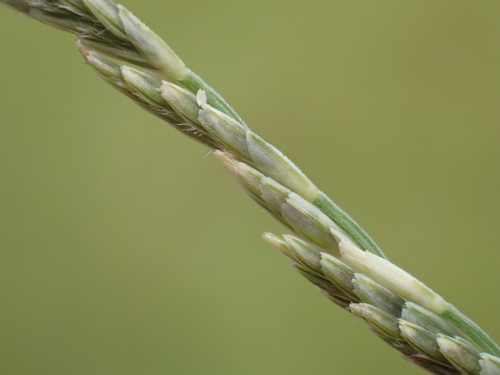
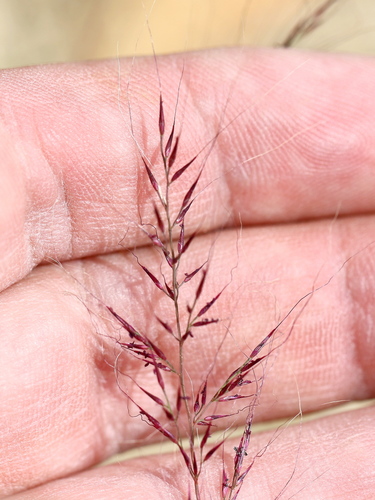
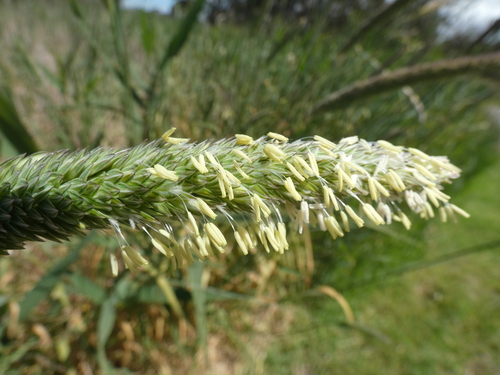
Phalaris aquatica L., commonly known as Harding grass, is an erect, stout, waist-high perennial bunch grass that has grayish to bluish green leaves. Its dense, spike-like flowering heads are typically 2 to 5 inches, or 50 to 125 millimeters, long. This species develops slowly from seed, but can grow into large bunches over the course of several years. It is a quick-growing grass that rapidly takes up and uses nitrogen from the soil. Phalaris arundinacea, also called reed canary grass, differs from Harding grass by having more distinct rhizomes and an inflorescence that starts compact and becomes more open as its branches spread. Hybrids between Harding grass and reed canary grass have been created. Recognized varieties of Phalaris aquatica include 'AQ1', 'Uneta', and 'Australis'. Phalaris aquatica originated in Southern Europe and the Caucasus. It has become naturalized in South Africa, Australia, New Zealand, and the United States. Though it was introduced very recently to Australia, that country was the first to recognize its value as a pasture grass. Domesticated cultivation of the species then spread to the United States, Argentina, several other South American countries, and New Zealand. Some Phalaris species contain gramine, a compound also found in the oat Avena sativa. Gramine is reported to cause brain damage, other organ damage, central nervous system damage, and death in sheep when injected in very large amounts. In Victoria, Australia, kangaroos that graze on Phalaris aquatica have been reported to develop a condition commonly called "Phalaris staggers", which impairs their coordination and mobility.