About Phalanta phalantha (Drury, 1773)
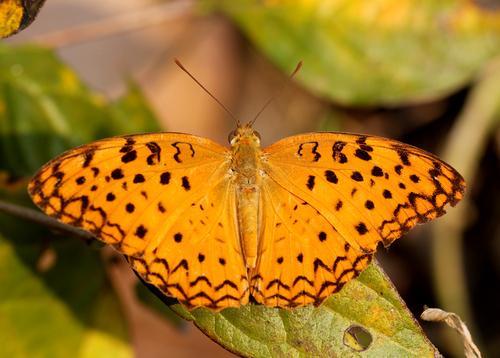
Phalanta phalantha, commonly known as the common leopard, is a medium-sized butterfly with a 50–55 mm wingspan. Its base color is tawny, and it is marked with black spots; males and females are similar in appearance. The underside of its wings is more glossy than the upperside, and dry-season forms have a more prominent purple gloss on the underside.
For the upperside wing pattern, both males and females have a bright yellowish-ochreous base color. The forewing features two short, slender, sinuous black bars across the middle of the cell, a similar darker pair at the end of the cell. Beyond this, a short, broad sinuous streak extends from the costa to the lower radial vein. Below the cell, this is followed by an inwardly-oblique series of four irregular-shaped spots. Further out, there is a medial-discal transverse row of similarly arranged narrow spots, an outer-discal row of round spots, then an inner submarginal sinuous line that is confluent with an outer straight line, and a marginal row of triangular spots. The hindwing has a faintly defined slender black lunule inside the cell, two black markings before the end of the cell, and two additional black markings above the cell. It also has a transverse inner-discal irregular series of slender lunules that have a slight pale external border, a medial-discal row of four larger black oval spots, two submarginal sinuous, slightly confluent lines, and marginal triangular spots.
The underside is paler than the upperside, and all markings are much less defined than on the upperside. The interspaces between the cell bars and outer markings are suffused with violet-grey, and the inner-discal series is outwardly bordered with greyish lunules. In some specimens, assumed to be dry-season forms, all markings on both the upperside and underside are less prominent. The body and palpi are yellowish-ochreous on the upper side; the underside of the body and palpi, along with the underside of the femora, are greyish-white. The tibia and tarsi are pale ochreous, and the antennae are ochreous-brown.
This butterfly occurs in Sub-Saharan Africa and southern Asia, including India, Bangladesh, Sri Lanka, and Myanmar, with multiple recognized subspecies: P. p. phalantha; P. p. luzonica Fruhstofer from the Philippines; P. p. columbina (Cramer) from southern China, Hainan, and possibly Taiwan; P. p. araca (Waterhouse & Lyell, 1914) from Australia; P. p. aethiopica (Rothschild & Jordan, 1903) from Madagascar, Seychelles, Aldabra, Comoro, and Tropical Africa; and P. p. granti (Rothschild & Jordan, 1903) from Socotra Island.