About Phaeomyias murina (Spix, 1825)
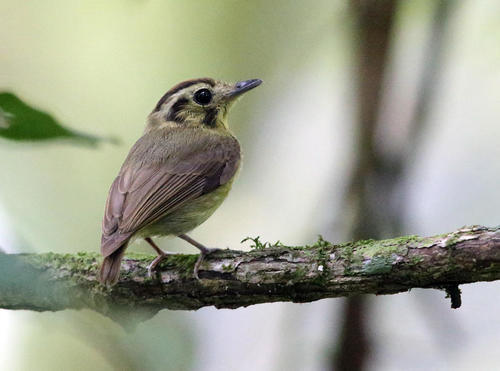
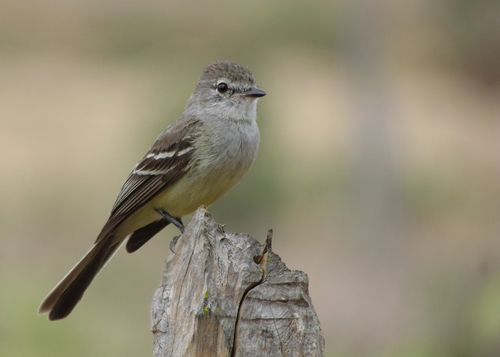
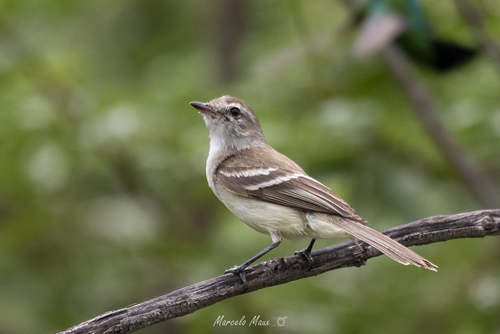
The mouse-colored tyrannulet, scientifically named Phaeomyias murina (Spix, 1825), measures 10.5 to 12.5 cm (4.1 to 4.9 in) long and weighs approximately 7 to 12 g (0.25 to 0.42 oz). The sexes have identical plumage. Adults of the nominate subspecies have an olive-brown to gray-brown crown, a broad but indistinct whitish to creamy supercilium, and a thin whitish eye ring; the rest of their face is pale grayish white to white. Their upperparts are colored olive-brown to gray-brown. Their wings are dusky, with wide whitish to dull cinnamon edges on the innermost flight feathers, and whitish to dull cinnamon tips on the coverts. Their tail is dusky. Their throat is pale grayish white to white. The center of their breast is whitish, and the sides are grayish; both areas carry a pale olive wash. Their belly and undertail coverts are pale yellow. Juveniles have the same appearance as adults. Subspecies P. murina wagae has less white on the throat, darker green-toned upperparts, and more intensely yellow underparts compared to the nominate subspecies. For both sexes, the iris is brown, the bill is thick, rounded, and horn-colored with pale pink at the base of the mandible, and the legs and feet are gray. This species is distributed from southern Costa Rica and Panama through Colombia, northeastern Ecuador, Venezuela, Trinidad, the Guianas, and Amazonia, extending as far east as Brazil, and south to Paraguay and northwest Argentina. It lives in a range of open to semi-open landscapes, most of which are arid or only moderately humid. Habitats include lowland and lower montane scrublands—especially those with Acacia and other trees with sparse foliage—cactus- and thorn scrub, cerrado, deciduous woodlands, gallery forest, young secondary forest, mangroves, parks, and gardens. Overall, it occurs at elevations from sea level up to 2,400 m (7,900 ft), but it is mostly found below 1,000 m (3,300 ft), and reaches only 500 m (1,600 ft) in Peru.