About Phacellodomus sibilatrix P.L.Sclater, 1879
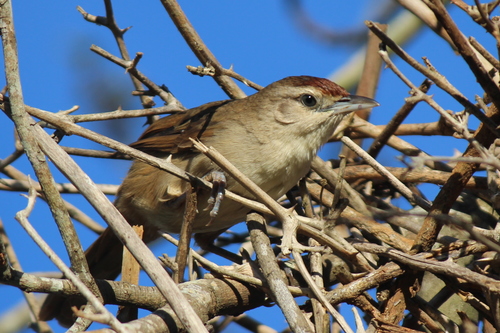
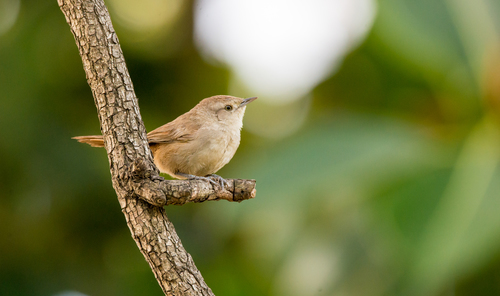
The little thornbird (Phacellodomus sibilatrix P.L.Sclater, 1879) measures 13 to 14 cm (5.1 to 5.5 in) long and weighs approximately 14 to 16 g (0.49 to 0.56 oz). It is the smallest species in its genus, and males and females have identical plumage. Adult little thornbirds have a wide, dull buff-whitish supercilium that extends past the eye, and an indistinct dull brown stripe behind the eye, with the rest of the face being light brownish. Their forehead is light rufous with pale streaks, their crown and back are dull brown, and their rump and uppertail coverts are brown with a rufescent tinge. Their wings are mostly various shades of brown, with darker brown primary coverts and some rufescence. For the tail, the central pair of feathers is dull brown, the next pair is mostly rufous with a brownish outer third, and all remaining tail feathers are bright rufous. Their throat and belly are dingy whitish, their breast is slightly darker than the throat and belly, and their flanks and undertail coverts are whitish with a tawny-brown tinge. Their iris ranges from greenish gray to dark brown, their maxilla is black to dark gray, their mandible is light horn-gray to gray, and their legs and feet are gray to pinkish gray. Juveniles have slightly darker upperparts and slightly grayer underparts compared to adults. The little thornbird is distributed in extreme southern Bolivia's Santa Cruz Department, western Paraguay, southwestern Uruguay, and northern Argentina as far south as Buenos Aires Province. There is also at least one recorded sighting of the species in extreme southwestern Rio Grande do Sul, Brazil. It inhabits tropical deciduous forest, Gran Chaco woodlands, savannah with scattered trees, and scrublands, and occurs at elevations ranging from near sea level to 2,000 m (6,600 ft).