About Phacellodomus ruber (Vieillot, 1817)
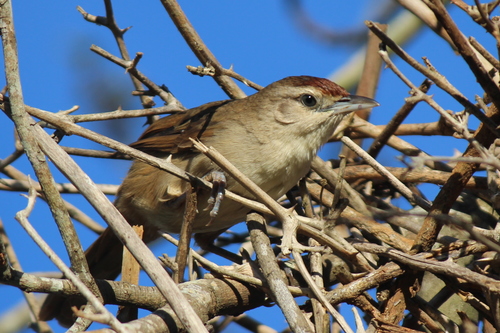
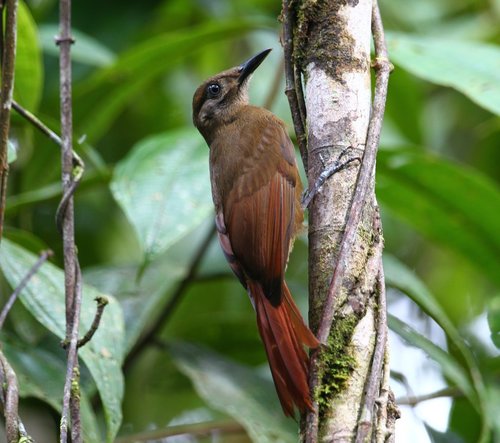
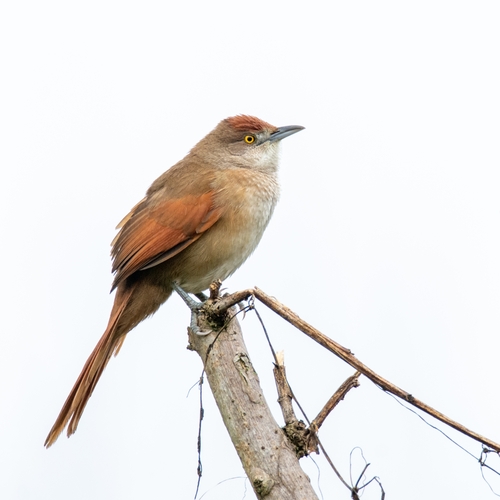
The greater thornbird, with the scientific name Phacellodomus ruber (Vieillot, 1817), measures 19 to 21 cm (7.5 to 8.3 in) in length and weighs approximately 35 to 51 g (1.2 to 1.8 oz). It is the heaviest and reddest species among thornbirds. Both sexes have identical plumage. Adults have a mostly rufescent brown to grayish brown face, marked by a paler supercilium, paler ear coverts, and a whitish malar area. The crown is reddish chestnut with pale streaks, the back is rich reddish brown to olive-brown that sometimes shifts to chestnut on the lower back, the rump is a lighter rufescent brown, and the uppertail coverts are chestnut. The wings are nearly uniform rufous-chestnut, and the tail is reddish chestnut. The throat is whitish, the breast is pale with a light brownish tinge, the belly is whitish, and the undertail coverts are light rufescent brown. The iris ranges from light yellow to orange, the maxilla is blackish to dark grayish horn, the mandible is pale gray to grayish green, and the legs and feet are gray to olive. Juveniles have a less defined crown patch than adults and display brownish mottling on the breast. This species is distributed across north-central and eastern Bolivia; from Bolivia east through Brazil to western Pernambuco and Bahia, and south to Rio Grande do Sul; through central Paraguay into northern Argentina as far as Corrientes Province; and into western Uruguay. The greater thornbird lives in a variety of landscapes, and it is almost always found near water. Common habitats include thickets along watercourses, gallery forest, the borders of marshes, and scrublands. Most of its populations occur between 300 and 1,100 m (1,000 and 3,600 ft) in elevation, though it locally reaches 1,400 m (4,600 ft) in Bolivia.