About Peucaea ruficauda (Bonaparte, 1853)
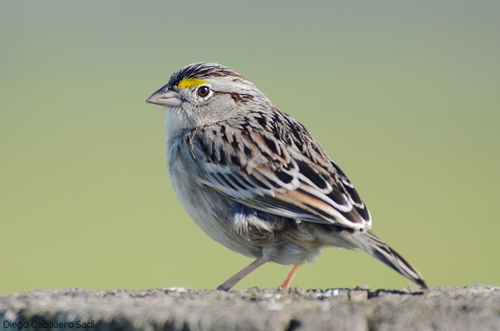
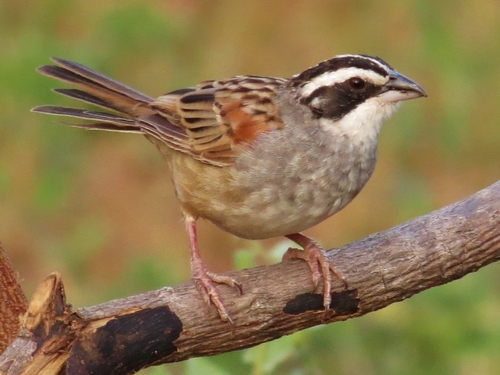
The stripe-headed sparrow, scientifically named Peucaea ruficauda, is an American sparrow. Its breeding range extends from Pacific coastal southwestern Mexico, including the transverse ranges and Cordillera Neovolcanica, to Pacific coastal northern Costa Rica. This is a common bird species. It occurs in lowlands at elevations up to 1,800 m (5,900 ft) in the northern portion of its range, and up to 800 m (2,600 ft) in Costa Rica. Its preferred habitats are brushy savannah, scrubby second growth, and woodland edges, and it does not enter forest interiors. The female stripe-headed sparrow builds the nest, which is a deep cup made from plant material lined with fine grass or horsehair. The nest is placed less than 1.2 m (3.9 ft) above ground in an isolated spiny scrub. The female lays two to four unmarked pale blue eggs, and incubates these eggs for 12 to 14 days. The entire social group helps feed the hatchlings, and all group members roost together tightly at night. The stripe-headed sparrow is a large, long-tailed sparrow species. It measures 15.5 to 18 cm (6.1–7.1 in) in length and weighs up to 35 g (1.2 oz). Adult individuals have a black head marked with broad white stripes on the crown and above each eye. The nape is narrowly grey, and the rest of the upperparts are pale brown; the back is streaked with black, while the rump and tail are unstreaked and more buff in color. The shoulders are rufous, and the wing feathers have buff edging. The throat and underparts are white, turning buff on the flanks, with a grey breast. Young birds have a duller, less distinct head pattern with buff stripes and a brown base color, and their breasts are streaked. There are four recognized subspecies of this sparrow. Overall, subspecies grow larger and brighter in coloration moving from the northern to southern end of the species' range. The northernmost subspecies, P. r. acuminata, is smaller than the nominate Costa Rican subspecies P. r. ruficauda. The nominate subspecies has duller, browner upperparts and paler, whiter underparts. The stripe-headed sparrow produces group vocalizations that sound like chattering squeaks. Males sing from open perches; their songs are made up of dry thin notes, and song patterns vary geographically. The subspecies P. r. ruficauda has a dry trill song, while P. r. acuminata's song is a series of double pechew notes. The stripe-headed sparrow forages for food on the ground. It feeds mainly on grass seeds, but also consumes some small insects and spiders. It is typically found in family groups or small flocks of up to seven birds. Its flight is low and fluttery, and it holds its tail low during flight.