About Peucaea cassinii (Woodhouse, 1852)
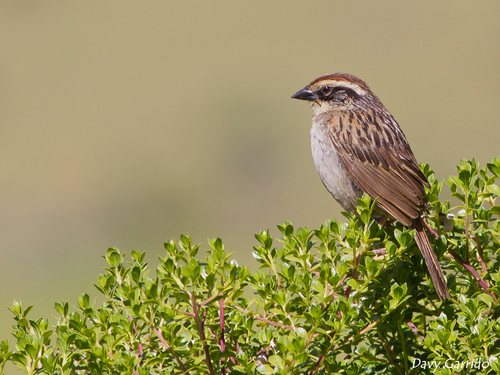
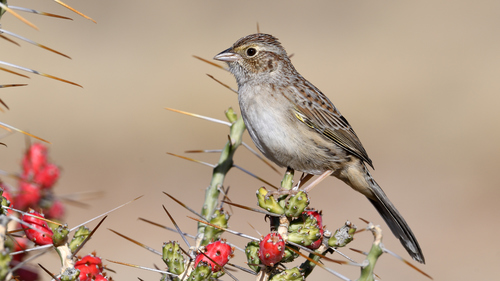
This species, commonly known as Cassin's sparrow, has a scientific name of Peucaea cassinii (Woodhouse, 1852). The sparrow has a long gray-brown tail with white corners, and dark markings on its back and sides. It resembles Botteri's sparrow in size and markings, but Botteri's sparrow has a paler gray shade. The most reliable way to distinguish the two species is by Cassin's sparrow's song. Males and females share the same gray coloration, and both measure 5 to 6 inches in length, though males are larger overall. Cassin's sparrow is a fairly large, plain grayish sparrow that does not have prominent conspicuous markings. When in flight, its long, roundish tail is clearly visible, and the white tips of its tail feathers can sometimes be seen. This species is most easily identified by its distinctive song and dramatic skylarking breeding behavior. Though literature often describes Cassin's sparrows as secretive and difficult to observe when they are not singing, Schnase (1984) found that these sparrows readily tolerate the presence of observers, especially early in the breeding season. Cassin's sparrows are most commonly found in brushy grassland and have nomadic movement patterns. Between 1955 and 1989, the species' population stayed below average, and its overall numbers fluctuate year to year. These sparrows occur in south-central states, and are rarely found in the northern portion of their range, which may be linked to rainfall patterns. The bird builds its nest in grass, using a mix of different weeds and grasses, and the female lays 3 to 5 eggs. While Cassin's sparrows use slightly different habitats across their range, all habitats they occupy require both a grass component, usually short grass, and a shrub component. The shrub component may consist of actual shrub species such as mesquite, sage (Artemisia spp.), hackberry (Celtis spp.), rabbitbrush (Chrysothamnus spp.), or oaks (Quercus spp.), or other vegetation with a shrub-like structure such as yucca (Yucca spp.), paddle cacti (Opuntia spp.), ocotillo, or bunch grasses. The need for structure from shrubs or similar plants relates to the sparrow's requirement for perches to sing from or launch its flight song, as well as its frequent use of low shrubs for nest placement. Schnase (1984) also noted that mesquite thickets within Cassin's sparrow territories were distinctly preferred when fledglings were present. Acceptable Cassin's sparrow habitat can accommodate a wide range of relative grass and shrub proportions, ranging from grassland habitats with very sparse shrubs to shrubland habitats with grass cover.