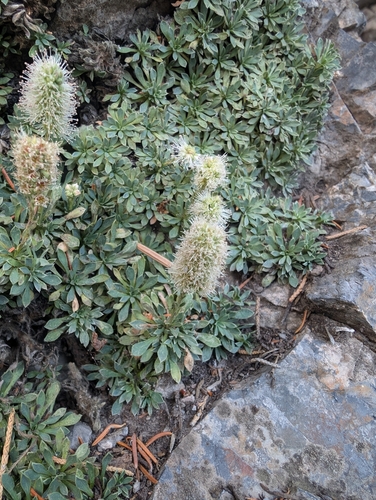
Petrophytum caespitosum (Nutt.) Rydb. is a plant in the Rosaceae family, order Rosales, kingdom Plantae. Not known to be toxic.

Photo of Petrophytum caespitosum (Nutt.) Rydb. (Petrophytum caespitosum (Nutt.) Rydb.)
🌿 Plantae

Petrophytum caespitosum (Nutt.) Rydb.

Petrophytum caespitosum (Nutt.) Rydb.

Petrophytum caespitosum is a low matted rock-growing shrub native to mountainous areas of the Western United States.

Family
Genus
Petrophytum
Order
Rosales
Class
Magnoliopsida
⚠️ Toxicity Note

Insufficient toxicity evidence; avoid direct contact and ingestion.

About Petrophytum caespitosum (Nutt.) Rydb.

Petrophytum caespitosum is a very low, matted shrub that forms creeping carpets up to 80 centimeters wide, growing over rocks. This species often grows on vertical rock surfaces, hanging in place via roots that cling to cracks in the rock. Its stems are thick, very short, and densely covered in rosettes of oval leaves. Both leaf surfaces are lightly covered in short, fine hairs that may not be visible without close inspection. The plant produces many inflorescences, which are spikelike flower clusters that grow from erect peduncles up to 10 centimeters tall. Each inflorescence is densely packed with individual flowers: every flower has five tiny white petals, many whiskery stamens, and usually five hairy pistils. After the flower parts dry, they may fall off, leaving behind a cluster of developing fruits called follicles that hold the plant's seeds. Petrophytum caespitosum is native to the Western United States, growing in mountainous areas ranging from the Sierra Nevada to the Rocky Mountains. It grows among limestone rocks in forested and woodland habitats, as well as on open limestone bluffs and cliffs.
Photo: (c) N.R. Jenzen-Jones, some rights reserved (CC BY-NC-SA), uploaded by N.R. Jenzen-Jones · cc-by-nc-sa

Taxonomy

Plantae Tracheophyta Magnoliopsida Rosales Rosaceae Petrophytum

More from Rosaceae

Sources: GBIF, iNaturalist, Wikipedia, NCBI Taxonomy · Disclaimer

Identify Petrophytum caespitosum (Nutt.) Rydb. instantly — even offline

iNature uses on-device AI to identify plants, animals, fungi and more. No internet needed.

Download iNature — Free

Start Exploring Nature Today

Download iNature for free. 10 identifications on us. No account needed. No credit card required.

Download Free on App Store