About Petrelaea dana (de Nicéville, 1884)
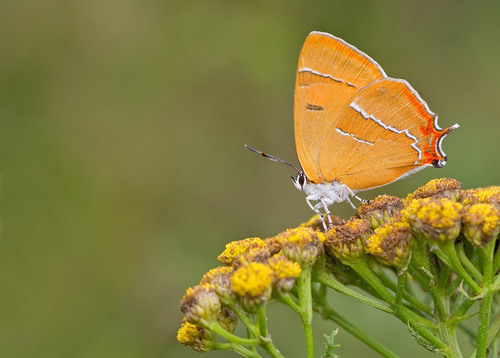
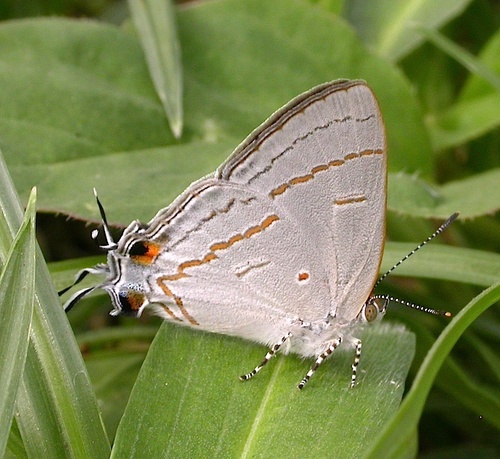
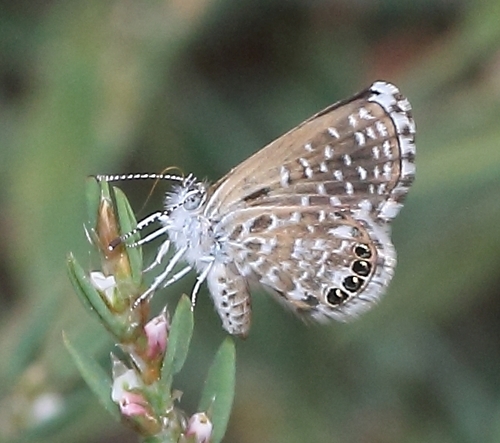
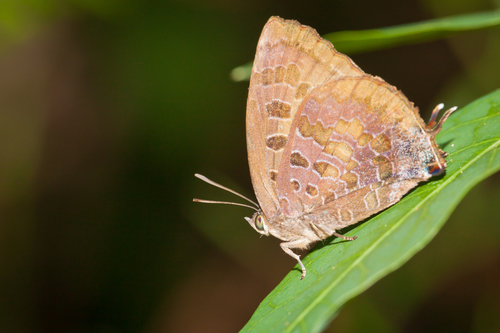
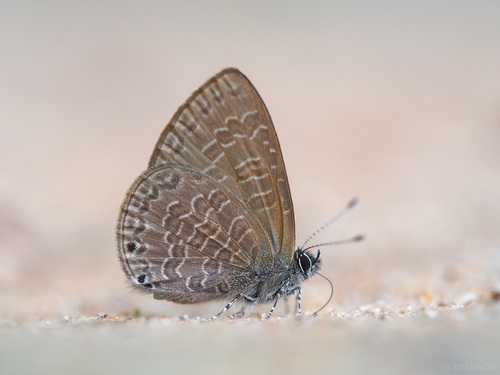
Male upperside of Petrelaea dana ranges from pale violet to dark bluish purple. Both forewings and hindwings are comparatively broad, with anteciliary brown lines that widen slightly at the apex of the forewing. On the hindwing, the costal and dorsal margins are narrowly paler and duller in colour than the rest of the wing, and the termen does not have a tail at the apex of vein 2. The underside ranges from dull hair-brown to ochraceous brown. On the forewing, there are two pairs of short, slender, transverse white strigae: the inner pair runs from the costa to the median vein across the middle of the cell, while the outer pair extends from the costa along each side of the discocellulars, stopping short at the lower apex of the cell. A transverse, discal, bisinuate, narrow catenulated (chain-like) band is formed of a double series of slender white lunules. This is followed by inner and outer subterminal series of transversely elongate spots, which are enclosed in or bordered on the inner and outer sides by obscure slender whitish lunules. Finally, the forewing has a dark brown anteciliary line. The hindwing is crossed by the following slender white lunular lines: two subbasal, two short lines near the apex of the cell, one on each side of the discocellulars, and two highly irregular, sinuous and broken lines on the disc. These lines are followed by some obscure lunular subterminal markings formed of dull white lines, with subterminal black spots in interspaces 1 and 2, and a dark brown anteciliary line. The antenna, head and abdomen are dark brown; the shafts of the antennae are ringed with white. The thorax is bluish purple. On the underside, the palpi and thorax bear mixed black and white hairs, and the abdomen is sullied white. On the female upperside, the costa and termen are very widely brownish, the dorsum is very narrowly brownish, and the colour is darkest at the apex. The middle two-thirds of the wing, from the base outward, is white with iridescent blue scales; there is a transverse dark discocellular spot, but no anteciliary dark lines. The female hindwing is dusky brown, with a slight bluish tint between the veins on the basal half of the wing. The female underside is pale ochraceous white, with the same markings found in the male. However, the female markings are dark ochraceous, so they stand out more distinctly. The female antennae, head, thorax and abdomen are dark brown; on the underside, the palpi and thorax are white, and the abdomen is pale ochraceous. This species is distributed from Kumaon to Sikkim, and is also found in Bhutan, Bengal, southern India (Nilgiris, Cochin), Chittagong, Upper Burma, Lower Burma, Tenasserim, Sri Lanka, and the Maldives.