About Petaurista philippensis (Elliot, 1839)
Physical Size
This is a large flying squirrel species, with a head and body length of approximately 43 cm and a tail length between 50 cm and 52 cm.
Fur Characteristics
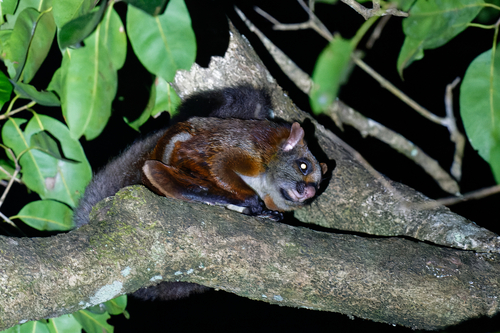
Its fur ranges from black to gray-brown: it is long and soft on the upper body, and somewhat shorter on the underside, giving the fur a grizzled appearance.
Gliding Membrane
A paler-colored wing membrane stretches between its forelimb and hindlimb, which enables the species to glide between trees.
Distinctive Markings
The hairy tail is colored blackish to gray-brown, the feet are black, and the nose is pale pink with black vibrissae.
Geographic Range
The species is native to China, India, Laos, Myanmar, Sri Lanka, Taiwan, Thailand, and Vietnam.
Habitat Preferences
It lives in dry deciduous and evergreen forests, most commonly at higher elevations between 500 m and 2,000 m (1,600 ft and 6,600 ft), and has also been recorded living on plantations.
Activity Pattern
The Indian giant flying squirrel is nocturnal and arboreal, spending most of its life in the forest canopy.
Nesting Behavior
It builds nests inside tree hollows, lining these nests with bark, fur, moss, and leaves.
Social Dynamics
When food is abundant, the species is sociable, but intraspecific attacks become more common when food is scarce.
Vocalization Trait
Its vocalizations are similar to those of the spot-bellied eagle-owl.
Reproduction Timing
For reproduction, females give birth to a single offspring in mid-June.
Newborn Traits
Newborn pups are born blind, and have a head that is disproportionately large compared to their body.