About Petasites hybridus (L.) G.Gaertn., B.Mey. & Scherb.
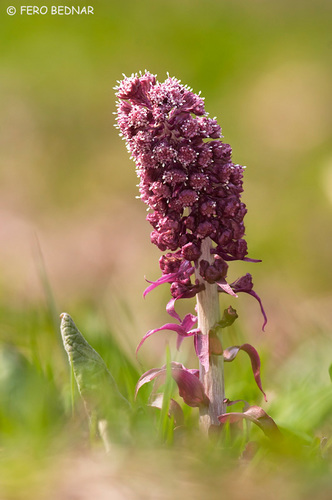
Petasites hybridus (L.) G.Gaertn., B.Mey. & Scherb. is a dioecious plant species, meaning male and female flowers grow on separate individual plants. In Britain, male plants are widespread, while female plants have a limited distribution restricted to northern and central England. Flowers emerge in early spring, before leaves develop; they are pale pink, with multiple inflorescences clustered on a stem that measures 5–20 cm (2–8 in) long. Leaves are large, borne on thick stems 80–120 cm (31–47 in) tall. Leaves are round, 40–70 cm (16–28 in) in diameter, with petioles that can grow up to 1.5 m (4 ft 11 in) long. This species is native to central Europe, with its native range stretching from the British Isles to the Caucasus, and from southern Italy to southern Scandinavia. It also occurs as an introduced species in North America. Within the British Isles, female plants are rarely found outside of central and northern England, and the species may exist as naturalized clonal populations outside this area, spreading via fragments of rhizome. It prefers to grow in moist, fertile soils, most often alongside rivers and streams, and in wet meadows. Retail-level butterbur extracts made from this species have been found to contain hepatotoxic pyrrolizidine alkaloids. Use of these extracts is not recommended during pregnancy or breastfeeding. The most common adverse effects of butterbur reported in clinical trials are gastrointestinal issues, including nausea, flatulence, and belching. In 2015, the American Academy of Neurology withdrew its original endorsement of butterbur over safety concerns. Long-term health effects and interactions between butterbur and other drugs have not been well documented. However, it is theoretically possible for butterbur to interact with certain blood pressure and heart medications, as well as drugs that induce the liver enzyme CYP3A4. Cases of liver damage have been reported in people taking butterbur, with adverse effects ranging from cholestasis and inflammation to liver failure. In Austrian and Czech traditional medicine, leaves of Petasites hybridus have been used both internally and externally. Internal uses include preparations as tea or cold ethanol maceration, while external uses include compresses or vinegar maceration. These preparations are used to treat infections, fever, flu, colds, hay fever, and allergies.