About Petasites frigidus (L.) Fr.
Petasites frigidus, commonly called Arctic sweet coltsfoot or Arctic butterbur, is a species of flowering plant in the Asteraceae family. It is native to Arctic through cool temperate regions of the Northern Hemisphere, including northern Europe, northern Asia, and northern North America.
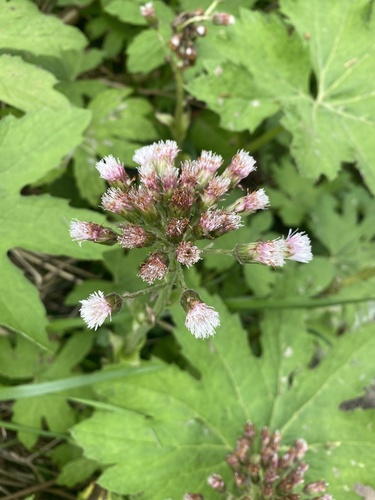
It is a herbaceous perennial plant that produces flowering stems in early spring, and large leaves throughout the summer. Upright flowering stems grow 10–20 cm (4–8 in) tall, and bear only 5–12 inflorescences that range in color from yellowish-white to pink. The leaves are rounded, 15–20 cm (6–8 in) broad, with a deeply cleft base and shallowly lobed margin, and grow directly from the underground rootstock. The underside of the leaves is covered in matted, woolly fuzz. It grows in moist, shaded ground, and prefers stream banks and seeping ground of cut-banks.
While there is some disagreement among sources, some identify five varieties of P. frigidus: Petasites frigidus var. frigidus; Petasites frigidus var. nivalis, sometimes referred to as P. nivalis or P. hyperboreus, which is common at subalpine and alpine elevations; Petasites frigidus var. palmatus, sometimes referred to as P. palmatus, palmate coltsfoot, or western coltsfoot, called mâl-ē-mē’ in the Konkow language (with tä-tä-tē’ and pē’-wē referring to the root); Petasites frigidus var. sagittatus, or arrowleaf sweet coltsfoot; and Petasites frigidus var. vitifolius.
For uses, the leaf stalks and flower stems (with flowers attached) are edible, and can be cooked and served as a vegetable dish. A salt substitute can also be made by drying and burning the leaves; the resulting black powdery substance has a salty taste. However, because this species very likely contains toxic unsaturated diester pyrrolizidine alkaloids, consumption should be very limited.