About Persoonia linearis Andrews
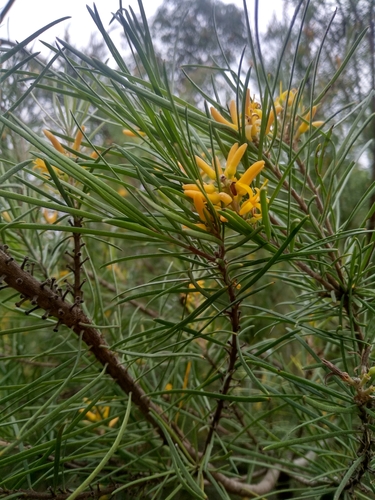
Persoonia linearis Andrews grows as a tall shrub to small tree. It occasionally reaches 5 m (16 ft) in height, but more commonly grows to around 2–3 m (6.6–9.8 ft) tall. Its soft, flaky bark is dark grey on the surface, while deeper bark layers are reddish. Epicormic buds located within the bark sprout new growth after bushfire. New growth of this species is hairy. Its leaves are roughly linear in shape, measuring 2 to 9 cm (0.79 to 3.54 in) long and 0.1 to 0.7 cm (0.039 to 0.276 in) wide, with slightly down-rolled margins.
Yellow flowers of Persoonia linearis appear in summer, autumn and early winter, from December to July, with flowering peaking over January and February. Flowers are arranged in leafy racemes, and each stem may bear up to 50 flowers. This species is auxotelic, meaning each stalk bears an individual flower that is subtended by a leaf at its junction with the stem. These stalks, called pedicels, are covered in fine hair and measure 2–8 mm in length. Each individual flower has a cylindrical perianth made up of tepals fused for most of their length, which contains both male and female reproductive parts. The tepals are 0.9–1.4 cm (0.35–0.55 in) long and covered in fine hair on the outside. The central style is surrounded by the anther, which splits into four segments that curl back and resemble a cross when viewed from above. These segments form a landing area for insects visiting the stigma, which sits at the tip of the style.
After flowering, Persoonia linearis produces smooth, fleshy, roughly round green drupes that measure 1.3 cm (0.5 in) in diameter. Mature drupes may develop purple blotches. Each drupe contains one or two seeds inside a woody "stone", and is shed once ripe, generally between September and November.
One of the most common geebungs, Persoonia linearis is found from the Macleay River catchment on the New South Wales Mid North Coast to the Tambo River in eastern Victoria. It occurs from sea level up to altitudes of 1,000 m (3,300 ft), in areas with an average yearly rainfall of 700 to 1,400 mm (28 to 55 in). It is a component of dry sclerophyll forest growing on both sandstone and clay soils, and grows in sunny to lightly shaded areas in open forest or woodland with a shrubby understory.
In the Sydney Basin, it grows alongside tree species including Sydney peppermint (Eucalyptus piperita), silvertop ash (E. sieberi), blue-leaved stringybark (E. agglomerata), blackbutt (E. pilularis), grey ironbark (E. paniculata), snappy gum (E. rossii), Sydney blue gum (E. saligna), narrow-leaved stringybark (E. sparsifolia) and smooth-barked apple (Angophora costata), and shrub species including Grevillea obtusiflora, G. phylicoides, Kowmung hakea (Hakea dohertyi), long leaf smoke bush (Conospermum longifolium) and stiff geebung (Persoonia rigida). Near Nowra and Jervis Bay, it is an understory component of the widespread Currambene Lowlands Forest community, growing alongside plants including gorse bitter pea (Daviesia ulicifolia), bearded heath (Leucopogon juniperinus) and native daphne (Pittosporum undulatum), with spotted gum (Corymbia maculata), white stringybark (Eucalyptus globoidea) and woollybutt (E. longifolia) as the dominant trees. This tall dry sclerophyll forest grows on hilly terrain with good drainage, over underlying yellow loam soil originating from mudstone, siltstone and sandstone.
Persoonia linearis is one of several Persoonia species that regenerate by resprouting from trunks or stems thicker than 2 cm (0.79 in) after bushfire, an adaptation to its fire-prone habitat. However, only larger trunks with a diameter of 12–16 cm (4.7–6.3 in) are likely to survive and reshoot after very hot fires. The thick papery bark shields and insulates the underlying epicormic buds from fire. The plant can reshoot from the base, but this generally only occurs if the stem or trunk is killed.
Colletid bees of the genus Leioproctus, subgenus Cladocerapis, exclusively forage on and pollinate flowers of many Persoonia species, including P. linearis. Bees of subgenus Filiglossa in the same genus, which also specialise in feeding on Persoonia flowers, do not appear to be effective pollinators. The fruit, which weighs an average of 1900 mg (0.07 oz), is adapted to be eaten by vertebrates such as kangaroos, possums, currawongs and other large birds. Seeds of P. linearis have been recorded in the faeces of the brush-tailed rock-wallaby (Petrogale penicillata).
In cultivation, Persoonia linearis is useful as a hedging plant and responds well to pruning. Its foliage has been used in floral arrangements, and its colourful bark is valued as a horticultural feature. It is fairly easy to grow in gardens, but is rarely seen due to difficulties in propagation. Seed germination rates are low, and germination can take many months. Once established, it can tolerate extended dry periods and is hardy to frosts. Optimum growing conditions are part shade and a well-drained acid soil, though P. linearis also grows readily in full sun. Persoonias in general are sensitive to excessive phosphorus, so they grow without fertiliser or with low-phosphorus slow-release formulations. They can also develop iron and manganese deficiencies.
Persoonia linearis was first cultivated in England in 1794 from seed, and was also reportedly propagated from cuttings. Andrews described it as a "handsome greenhouse plant, continuing to flower through the autumnal months and producing good seeds." Joseph Knight reported that cuttings would be successful as long as material was "judiciously chosen", and that cultivated plants had set seed on occasion. In 1994, a compound with antimicrobial activity was isolated from the ripening drupes of a hybrid of Persoonia linearis and P. pinifolia growing in the Australian National Botanic Gardens, and was identified as 4-hydroxyphenyl 6-O-[(3R)-3,4-dihydroxy-2-methylenebutanoyl]-β-D-glucopyranoside.