About Persicaria perfoliata (L.) H.Gross
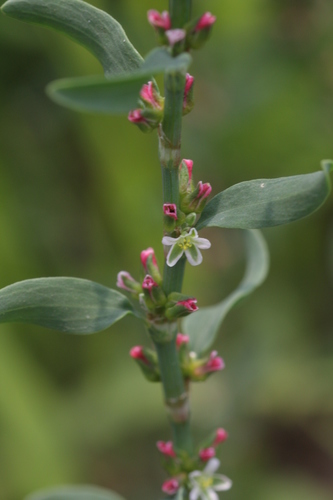
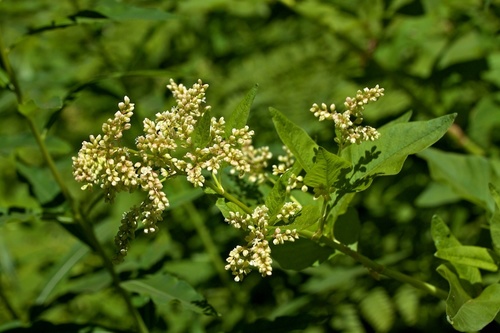
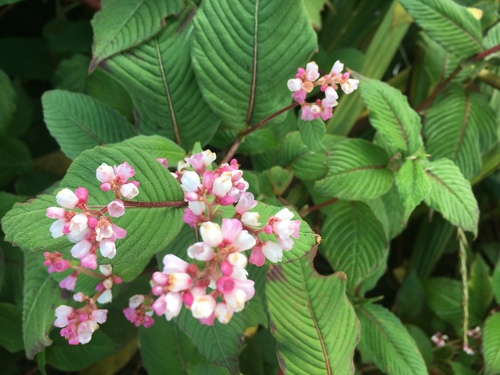
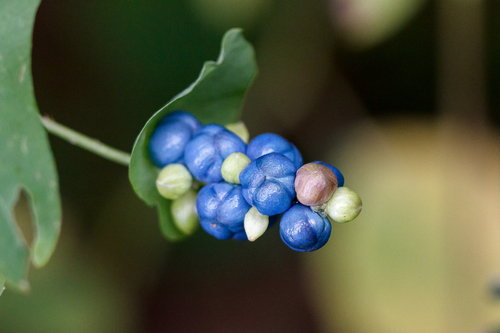
Persicaria perfoliata has a reddish stem armed with downward-pointing hooks or barbs, which are also found on the underside of its leaf blades. Its light green leaves are shaped like an equilateral (equal-sided) triangle and grow in an alternating pattern along narrow, delicate stems. Distinctive circular, cup-shaped leafy structures called ochreas surround the stem at regular intervals. Flower buds, and later flowers and fruits, emerge from inside these ochreas. The flowers are small, white, and generally inconspicuous. The edible fruits are attractive, metallic blue and segmented, with each segment holding a single glossy, black or reddish-black seed.
Persicaria perfoliata prefers warm open areas, including wood edges, wetlands, stream banks, roadsides, and uncultivated open fields formed by both natural and human activity. It also grows in dense wooded areas where the overstory has opened, increasing sunlight reaching the forest floor. Typical locations to find P. perfoliata include natural areas like stream banks, parks, open space, road shoulders, forest edges, and fence lines. It also grows in extremely wet environments with poor soil structure. Both available light and soil moisture are essential for this species to successfully colonize an area. It can tolerate partial shade for part of the day, but requires 63-100% of available full light. A key survival trait of P. perfoliata is its ability to attach to other plants with its recurved barbs and climb over them to reach areas of high light intensity. It can survive in areas with relatively low soil moisture, but prefers conditions with high soil moisture.
Persicaria perfoliata is primarily a self-pollinating plant, a trait supported by its inconspicuous, closed flowers that produce little scent, with occasional outcrossing. It produces fruits and viable seeds without assistance from pollinators. Vegetative propagation from roots is not successful for this species. It is a very tender annual that withers after a light frost, and reproduces successfully until the first frost of the season. P. perfoliata is a prolific seeder: a single plant produces many seeds over a long growing season, from June to October in Virginia, with a slightly shorter season in more northern geographic areas. It can spread up to 30 feet (9.1 m) in a single season, and may grow even larger in the southern United States.
Birds are likely the primary long-distance dispersal agents for P. perfoliata seeds. Short-distance transport of seeds by native ant species has been observed, an activity likely encouraged by a tiny white food body called an elaiosome on the tip of the seed, which is attractive to ants. These seed-carrying ants may play an important role in the survival and germination of P. perfoliata seeds. Local bird populations support dispersal under utility lines, near bird feeders, along fence lines, and at other perching locations. Other animals observed eating its fruits include chipmunks, squirrels, and deer. Water is also an important mode of dispersal. Its fruits can remain buoyant for 7 to 9 days, an advantage for dispersing seeds over long distances through streams and rivers. The species' long vines frequently hang over waterways, allowing detached fruits to be carried away by water currents.
In traditional Chinese medicine, Persicaria perfoliata is known as gangbangui (Chinese: 杠板归; pinyin: gāngbǎngūi), and is considered useful for various herbal remedies. It can also be used to produce fiber or for making rope.