About Persicaria maculosa Gray
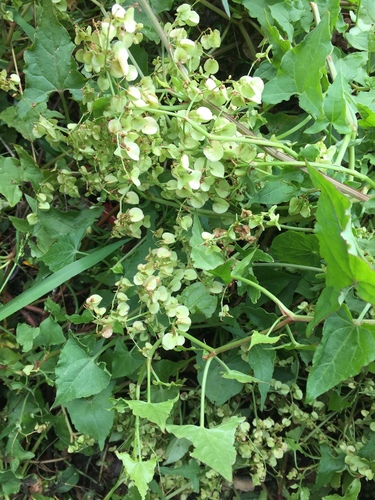
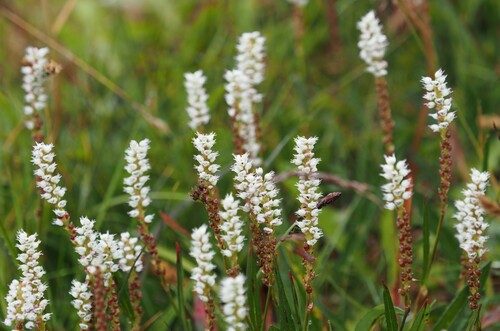
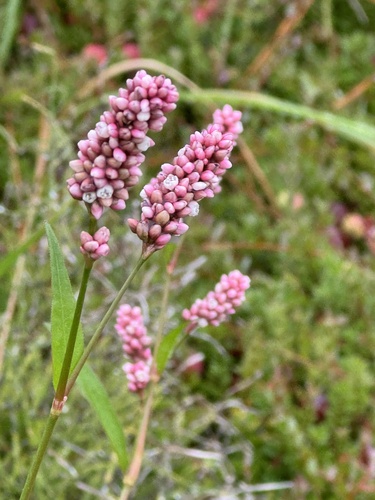
Persicaria maculosa Gray is an annual herb that grows up to 1 metre (3 ft 3 in) tall. It has an erect, rather floppy stem with swollen joints. Its leaves are arranged alternately, and are almost stalkless. The leaf blades are narrowly ovate with entire margins, and often have a brown or black spot in their centre. Each leaf base has stipules that are fused into a sheath that encloses the stem; this sheath is loose, and fringed with long hairs at its upper end. The plant's inflorescence is a dense spike. Each tiny pink flower has a perianth made of four or five lobes that are fused near the base. Each flower has six stamens, two fused carpels, and two styles. The fruit produced is a shiny black, three-edged achene. In the temperate Northern Hemisphere, this plant flowers from July to September. Persicaria maculosa is native to Europe and Asia. In this range, it can be mistaken for Polygonum minus, which differs by having narrower leaves that are usually less than 1 cm wide. It has been introduced to North America, where it is naturalized across the entire mainland continent. It grows along roadsides, riverbanks, and on fallow ground. In the United States, it is very similar to Pennsylvania smartweed, but Persicaria maculosa (also called redshank) has a fringe of hairs at the top of the ochrea, a feature that Pennsylvania smartweed does not have. This species has also been found in New Zealand and Australia. In the British Isles, this plant is a weed with no native natural habitat, and is always found in association with human activity. It prefers moist soils, especially rich soils and acid peaty loams. It does not tolerate lime, and liming is noted as a method to control this plant. Persicaria maculosa contains persicarin and tannins. Its young leaves can be eaten as a leaf vegetable. It is often considered a weed and is rarely cultivated. A yellow dye can be produced from this plant, with alum used as a mordant.