About Persicaria longiseta (Bruijn) Kitag.
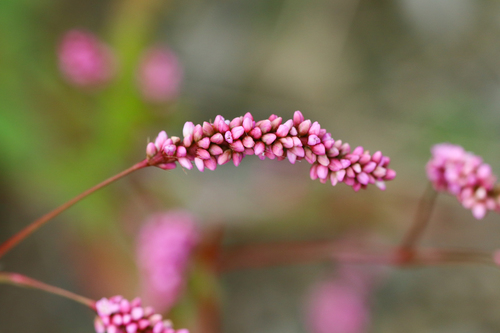
Persicaria longiseta is a flowering plant species belonging to the knotweed family. It has many common names, including Oriental lady's thumb, bristly lady's thumb, Asiatic smartweed, long-bristled smartweed, low smartweed, Asiatic waterpepper, bristled knotweed, bunchy knotweed, and tufted knotweed. This plant is native to Asia, occurring across regions including China, India, Russia, Japan, and Malaysia. It has been introduced to North America and Europe, where it often grows as a weed. It is an annual herb, with stems measuring 30 to 80 centimeters (12 to 32 inches) long, and occasionally reaching up to one meter (40 inches) in length. Its hairless, branching stems can grow roots at lower nodes that touch the growing substrate. Its leaves are lance-shaped, reaching up to 8 centimeters (3.2 inches) long and 3 centimeters (1.2 inches) wide, and have bristly ochrea. Its inflorescence is an elongated cluster up to 8 centimeters (3.2 inches) long that holds many pink flowers. It produces small, smooth achene as fruit. Within its native range, the plant is a common weed of rice paddies. It was first introduced to North America near Philadelphia around 1910, and likely spread across the continent via railroads. It is currently found across most of the eastern United States and most of Canada. It can grow in moist habitat types including wetlands, as well as in dry and upland habitats. It can be found growing in meadows, marshes, mudflats, riverbanks, floodplains, levees, and both lowland and upland forests. It is considered invasive in some areas.