About Pernis apivorus (Linnaeus, 1758)
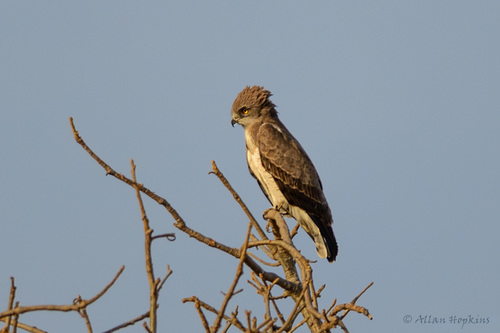
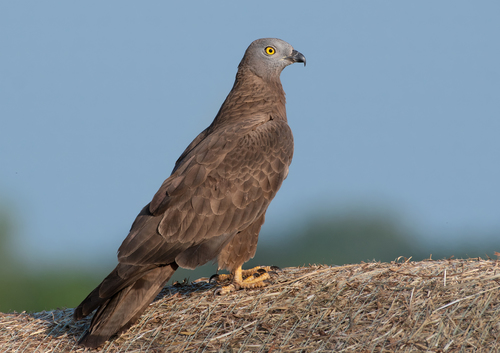
This species, Pernis apivorus, commonly known as the European honey buzzard, measures 52 to 60 centimetres (20 to 24 inches) in length, with a wingspan of 135 to 150 centimetres (53 to 59 inches). It is larger, longer-winged, longer-necked, and longer-tailed than the smaller common buzzard (Buteo buteo), and has a small head. It soars on flat wings. Its tail has fewer bars than the common buzzard's tail, usually featuring two narrow dark bars and one broad dark subterminal bar. Unlike most large birds of prey, male and female European honey buzzards can be distinguished by their plumage. Males have a blue-grey head, while females have a brown head; females are also slightly larger and darker than males. The species' soaring outline (jizz) is quite distinct. Its wings are held straight, with wing tips positioned horizontally or sometimes slightly pointed downward. The head protrudes forward with a slight downward kink, and a very angular chest similar to that of a sparrowhawk can sometimes be seen, though this feature is not considered distinct. The angular chest is most noticeable when the bird is seen in direct flight with its tail narrowed. Its call is a clear peee-lu. The European honey buzzard is a summer migrant that breeds in a relatively small area of the western Palearctic, ranging across most of Europe eastward to southwestern Siberia. Its exact eastern range boundary is not yet confirmed, but it is thought to lie around Tomsk, Novosibirsk, and Barnaul. It can be found in a wide variety of habitats, but generally prefers woodland and exotic plantations. It migrates to tropical Africa to overwinter.