About Peristeranthus hillii (F.Muell.) T.E.Hunt
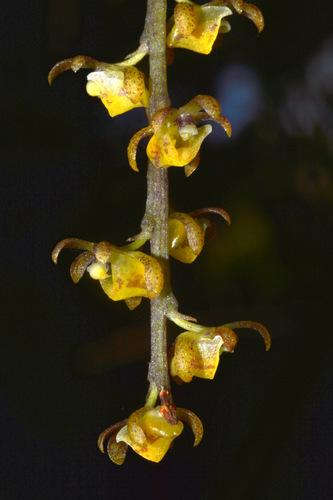
Peristeranthus hillii is an epiphytic or lithophytic herb that produces one or two shoots, with more or less pendulous stems measuring 30–250 millimetres (1.2–9.8 in) long. Each stem bears between three and ten narrow oblong leaves 150–250 millimetres (5.9–9.8 in) long and 15–40 millimetres (0.59–1.6 in) wide. The leaves have many parallel veins, a drooping tip, and are often twisted. Between 25 and 75 pale green flowers, often marked with crimson, are borne on pendulous flowering stems 150–250 millimetres (5.9–9.8 in) long; individual flowers are 6–8 millimetres (0.24–0.31 in) long and 5–7 millimetres (0.20–0.28 in) wide. The sepals and petals spread widely apart from one another, and are about 3 millimetres (0.12 in) long and 1 millimetre (0.039 in) wide. The labellum is yellow with red spots, about 2.5 millimetres (0.098 in) long and 3 millimetres (0.12 in) wide, and has three lobes. The side lobes are triangular, and the middle lobe has a hollow, tapered spur. Flowering occurs from September to October. This species mainly grows on tree trunks and vines in tropical highland rainforest, and in coastal and near-coastal subtropical regions. It occurs between the Bloomfield River in Queensland and Port Macquarie in New South Wales.