About Perisoreus infaustus (Linnaeus, 1758)
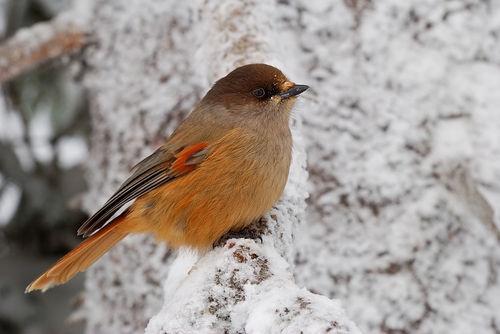
The Siberian jay, with the scientific name Perisoreus infaustus (Linnaeus, 1758), is the smallest corvid species found in western Palearctic. Adults weigh between 75 to 90 g (2.6 to 3.2 oz) and reach around 30 centimetres (12 inches) in total length. Adult plumage is overall greyish brown, with a dark brown head, paler forehead, and buff-colored breast. The rump is yellowish, while the chin and throat are grey. Rufous streaking appears on the outer feathers, and the bill and legs are both black. The species’ overall coloration is fairly inconspicuous, helping it hide from predators within its forest habitat. Its plumage is also very soft and downy, which provides insulation against extreme cold winter temperatures. The Siberian jay undergoes one moult per year, which runs from mid-June to mid-September. The longest recorded lifespan for a ringed individual in Finland is 13 years and 4 months, while the reported average lifespan for the species is 7.1 years. Siberian jays are specially adapted to navigate flight through dense forest, but they are rather cumbersome when flying across open terrain. This trait likely explains their vulnerability to raptor predation when they are outside of forested areas. The Siberian jay is a non-migratory resident that lives in northern boreal forests of spruce, pine, cedar, and larch, stretching from Scandinavia across northern Russia to Siberia. It has an extensive total range, estimated at 19,300,000 square kilometres (7,500,000 square miles), and is native to Norway, Sweden, Finland, Russia, Mongolia, Kazakhstan, and China. It occurs only as a vagrant in Belarus, Estonia, Latvia, Poland, Slovakia, and Ukraine. While the species is largely sedentary, some individuals in the eastern part of its range may move southward during winter. This species prefers dense, mature closed-canopy forest habitat in lowland and foothill areas. Spruce forests are its preferred habitat for foraging and nesting, because spruce’s denser foliage provides better concealment from predators than the foliage of other local conifers. Higher breeding success for this species is linked to higher foliage density, as dense foliage creates better hiding spots for eggs and nestlings, making them less likely to attract predators. The benefit of increased predator evasion from extra hiding space appears to outweigh the downside of making it harder for jays to spot predators within the dense foliage. The Siberian jay is notably selective when choosing a territory. A typical territory contains an old dense spruce swamp with ample vegetation cover, and territories tend to be structurally diverse, including scrub of various ages, groves, and flood meadows. Because of this, active Siberian jay territories can be used as an indicator of high ecological diversity in a forest. The species has a complex, unusual social structure. Siberian jays live in small flocks of 2 to 7 individuals, with a dominant breeding pair at the center of the group. Flocks also include retained multigenerational offspring and unrelated immigrant individuals. There is a clear dominance hierarchy within groups: males are dominant over females, and breeders are dominant over non-breeders. Some male non-breeders are even dominant over female breeders. Flock composition varies: some flocks include only family groups plus associated unrelated immigrants, while other flocks are made up entirely of unrelated individuals. Unrelated immigrants can be tolerated within a territory outside of nesting areas. Siberian jays act aggressively toward unrelated intruders that enter their territory. Two distinct aggressive responses have been observed in territory holders at feeding grounds: in the first, the intruder is approached and forced away; in the second, the intruder is chased while in flight. Chasing during flight is more energetically costly for the aggressive territory holder. While breeders are considerably more aggressive toward immigrants than toward their own retained offspring, aggressive responses are shaped by existing social dominance within groups. For example, females receive significantly more aggression than males, because males offer more resistance due to their higher social ranking, which creates a higher energy cost for the aggressor that attacks a male. Experiments show that Siberian jays recognize their own young through associative learning rather than through genetic cues; tested individuals did not differentiate between their own biological offspring and fostered offspring.