About Perisoreus canadensis (Linnaeus, 1766)
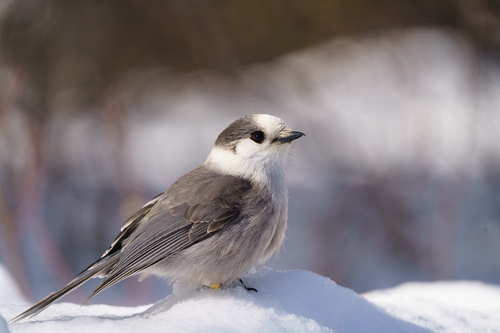
The Canada jay (scientific name Perisoreus canadensis (Linnaeus, 1766)) is a relatively large songbird, though it is smaller than other jays. A typical adult Canada jay measures between 25 and 33 cm (9.8 and 13.0 in) in length, has a wingspan around 45 cm (18 in), and weighs approximately 65 to 70 g (2.3 to 2.5 oz). Adult Canada jays have medium grey back feathers with a lighter grey underside. Most of their head is white, with a dark grey or black nape and hood; they also have a short black beak and dark eyes. Their long medium grey tail has lighter tips, and their legs and feet are black. Their plumage is thick, to provide insulation in their cold native habitat. Like most corvids, Canada jays are not sexually dimorphic, but males are slightly larger than females. Juvenile Canada jays are initially entirely very dark grey all over, and gain adult plumage after their first moult in July or August. The average lifespan of territory-owning Canada jays is eight years; the oldest known Canada jay that was banded and recaptured in the wild was at least 17 years old. Canada jays use a variety of vocalizations, and like other corvids, they may mimic other bird species, especially predators. Their calls include a whistled quee-oo, as well as various clicks and chuckles. When a predator is spotted, the bird produces a series of harsh clicks to signal a threat on the ground, or a series of repeated whistles to indicate a predator in the air.
Canada jays have a range that spans across northern North America, from northern Alaska east to Newfoundland and Labrador, and south to northern California, Idaho, Utah, east-central Arizona, north-central New Mexico, central Colorado, and southwestern South Dakota. They are also found in the northern parts of Minnesota, Wisconsin, Michigan, the Adirondacks in New York, and New England. Canada jays may wander north of their breeding range. In winter, they travel irregularly to northwestern Nebraska, central Minnesota, southeastern Wisconsin, central Michigan, southern Pennsylvania, central New York, Connecticut, and Massachusetts. Fossil evidence shows that Canada jays lived as far south as Tennessee during the last ice age. The vast majority of Canada jays live in areas with a strong presence of black spruce (Picea mariana), white spruce (P. glauca), Engelmann spruce (P. engelmannii), jack pine (Pinus banksiana), or lodgepole pine (P. contorta). Canada jays do not live in the snowy, coniferous Sierra Nevada of California, which may seem like appropriate habitat, because no spruce grow there. They also do not live in lower elevations of coastal Alaska or British Columbia that are dominated by Sitka spruce (Picea sitchensis). Key habitat requirements may include sufficiently cold temperatures to support successful storage of perishable food, and tree bark with pliable scales arranged in a shingle-like configuration that lets Canada jays easily wedge food items into dry, concealed storage locations. Storage may also be aided by the antibacterial properties of the bark and foliage of boreal tree species. One exception to this general pattern is the well-marked subspecies P. c. obscurus, which lives right down to the coast from Washington to northern California, even in the absence of cold temperatures or the thought-to-be necessary tree species.