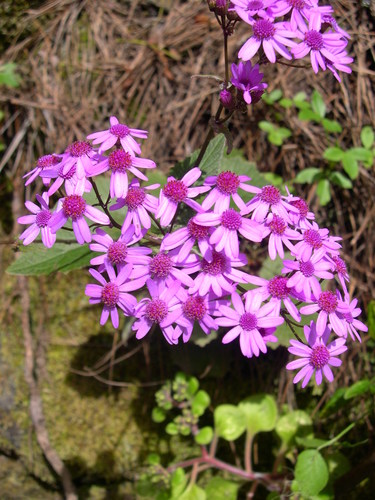
About Pericallis cruenta (L'Hér.) Webb & Berthel.
Pericallis cruenta has the scientific synonyms Senecio cruentus and Cineraria cruenta, and is a flowering plant species belonging to the family Asteraceae. It is native to the Canary Islands, specifically the islands of La Gomera and Tenerife. This species has a non-woody growth form, and it is most commonly found growing in the laurel forests of Tenerife. Along with Pericallis lanata, P. cruenta is one of the parent species of the widely cultivated garden plant Pericallis × hybrida, which is commonly known as florist's cineraria. There has been longstanding confusion and debate, from the past through to the present day, over the identity and origin of Pericallis × hybrida. This confusion has led to Pericallis cruenta being incorrectly labeled as a 'feral' form of florist's cineraria. In 1895, William Turner Thiselton-Dyer argued in a series of letters and articles published in The Gardeners' Chronicle and Nature that the cultivated garden plant Cineraria cruenta was developed through simple selective breeding from the wild plant then known as Senecio cruentus. William Bateson disagreed, arguing instead that the garden plant had a hybrid origin. The debate was eventually resolved when Bateson partnered with Richard Irwin Lynch, the Curator of the Cambridge University Botanic Garden, who carried out experimental crosses in 1897. The results of these crosses were published in 1900, and clearly confirmed that garden cineraria is of hybrid origin. In fact, plants of the genus Pericallis had first been brought to England in 1777 and 1780, and horticulturalists had already created extensive hybrids from these plants by the early 1800s. By the time of the 1895 debate, numerous cultivars with a wide range of morphological variation already existed.