About Peribatodes rhomboidaria (Denis & Schiffermüller), 1775
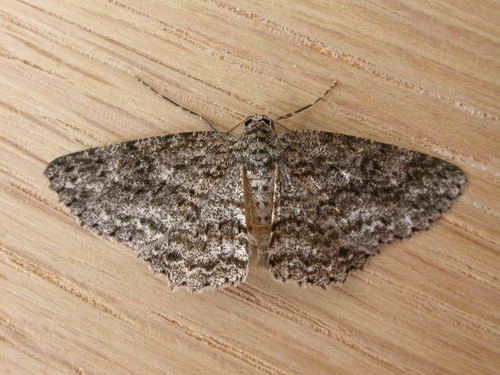
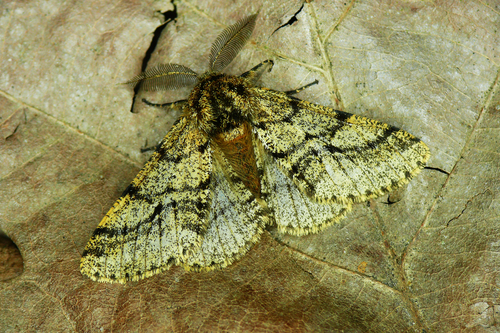
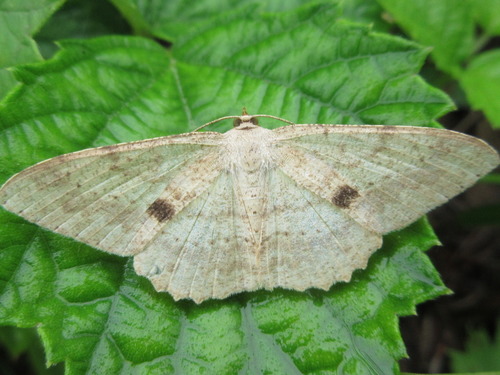
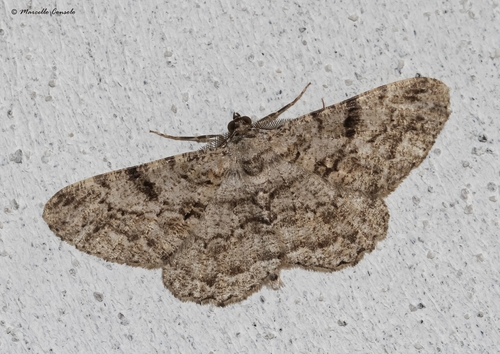
This species, known scientifically as Peribatodes rhomboidaria (Denis & Schiffermüller), 1775, has an adult wingspan of 40–48 mm. Its wings are whitish-grey or whitish-yellowish, but appear buff or grey from a distance due to heavy speckling with brown or black dots. Two blackish semicircular bands, common to moths in the Ennominae subfamily, run across both the forewings and hindwings; these bands are broken and somewhat indistinct in this species. A distinctive identifying trait is a single bulge in the forewing section of the outer blackish band. Dark (melanic) forms, for example the form rebeli, occur sometimes. The two sexes can be told apart by their antennae: males have strongly feathered antennae, while females have almost smooth antennae. This moth lives in woodland, gardens, and similar habitats. Populations produce either one or two generations per year, depending on location. Adults fly during the summer: in the British Isles they are active from June to September, while in the more continental climate of Austria, they are rarely seen by late August. They fly at night and are attracted to light. The caterpillar larva is reddish-brown and feeds on a wide variety of trees and shrubs. Despite the species' common name of willow beauty, it rarely or never feeds on willows (Salix). This species overwinters as a small larva. Based on its recorded distribution, it does not appear to tolerate severe, dry winters well. The willow beauty larva is highly polyphagous and not adapted to feed on a single specific lineage of food plants. Instead, it consumes the foliage of a wide range of eudicots, as well as some other types of plants. Recorded food plants include Betula (birch), Camellia sinensis (tea), Clematis (clematises) – not recorded in Finland, Crataegus (hawthorn), Hedera (ivy), Ligustrum (privet) – not recorded in Finland, Malus (apple), Prunus (plum, cherry, peach) – including blackthorn (P. spinosa) – not recorded in Finland – and possibly others, Taxus (yew), and Vitis (grapevine).