About Pereskia grandifolia Haw.
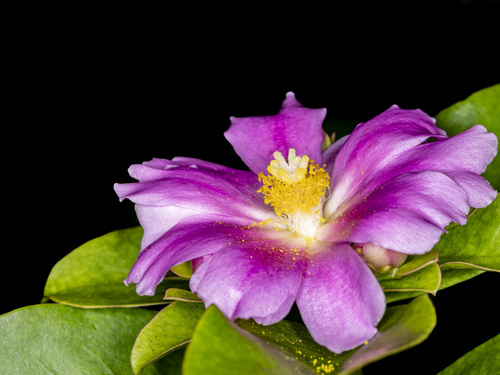
Although Rhodocactus grandifolius (also classified under the scientific name Pereskia grandifolia Haw.) is a cactus, it grows as a shrub or small tree. It typically reaches 2–5 m (7–16 ft) in height, and may exceptionally grow to 10 m (33 ft) tall. Young twigs are green or reddish, with conspicuous white spots marking the stomata. Its trunk has grayish-brown bark and reaches a diameter of up to 20 cm (8 in). The areoles are rounded and cushion-shaped, covered in grayish or brownish tomentum. On twigs, areoles are 3–7 mm (0.1–0.3 in) across, and reach up to 12 mm (0.5 in) across on the main trunk. In addition to spines, areoles can produce one to three, or occasionally four, brachyblast leaves. Spines range in color from black to brown, and the number of spines per areole gradually increases as the plant ages. New twigs may have spineless areoles, while trunk areoles may hold up to 90 spines, each 2–6.5 cm (0.8–2.6 in) long. Leaf size varies; leaves are usually 3–9 cm (1.2–3.5 in) long, but may be shorter or reach up to 30 cm (11.8 in) long. The leaf margins are entire, and leaf shapes range from elliptic to ovate and obovate-lanceolate. Dense inflorescences develop at the tips of stems, and also grow laterally from areoles on the upper sections of main shoots and twigs. Inflorescences usually hold 10 to 15 flowers, and sometimes produce 30 or more. The flowers are showy, rose-like, and vary in color from pale pink to purplish-pink, measuring about 3–5 cm (1.2–2.0 in) across. The fruit varies greatly in size and shape, and is green, yellowish, or reddish-green when ripe. It contains many glossy black seeds. The full species is native to eastern and southern Brazil. It is widely cultivated in other parts of South America, the West Indies, and beyond, and has become naturalized in some of these regions, including Vietnam. Rhodocactus grandifolius var. grandifolius has a similar distribution to the full species, while Rhodocactus grandifolius var. violaceus is apparently native to Espírito Santo and Minas Gerais, and is cultivated in neighboring states. Rhodocactus grandifolius is grown as an ornamental plant, valued for its flowers. It is also used to form hedges. Its leaves can be eaten raw in salads or cooked in stews.