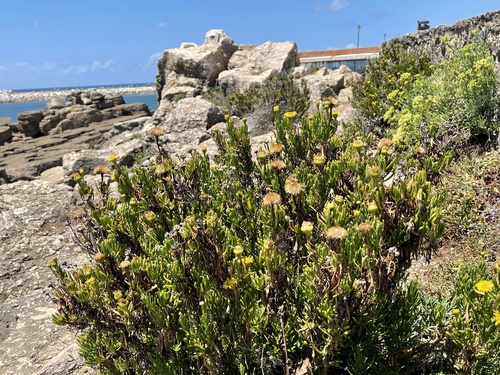
About Pentanema squarrosum (L.) D.Gut.Larr., Santos-Vicente, Anderb., E.Rico & M.M.Mart.Ort.
Plant Size and Growth Form
Ploughman's spikenard, scientifically named Pentanema squarrosum (L.) D.Gut.Larr., Santos-Vicente, Anderb., E.Rico & M.M.Mart.Ort., is a softly hairy plant that grows up to around 130 cm tall. It has a much-branched, often purplish stem, an irregularly thickened taproot, and is typically a biennial or short-lived perennial that forms an overwintering rosette.
Aroma Characteristics
Its leaves and roots are aromatic, especially in spring, with a faint spicy scent similar to cinnamon or cumin.
Leaf Hair Structure
Its leaves are covered in soft fur made of long, simple hairs, which are thicker on the leaf veins than on the leaf blades.
Basal Leaf Traits
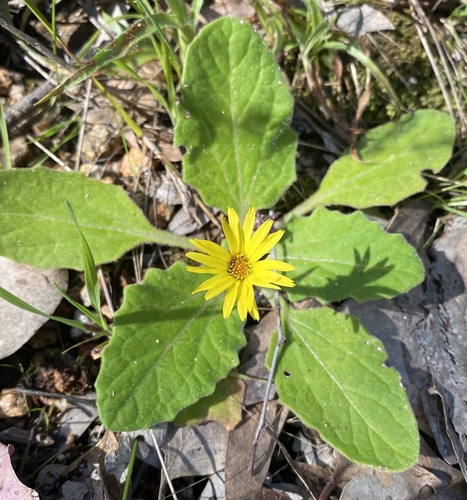
Basal leaves grow up to 15 cm long, are ovate to lanceolate with slightly pointed tips, and have a short petiole that clasps the stem (a trait called semiamplexicaul).
Upper Leaf Traits
Upper leaves are gradually smaller and narrower, with shorter petioles, and the topmost leaves have no petiole (are sessile).
Flowering Period
Flowering takes place in late summer.
Inflorescence Structure
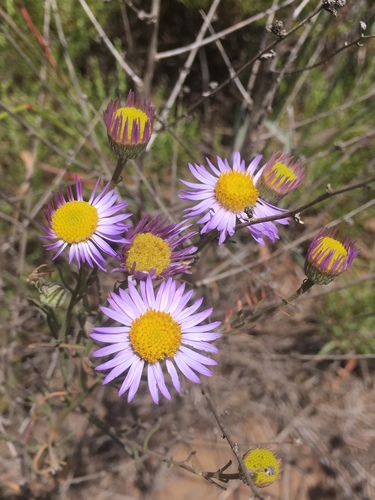
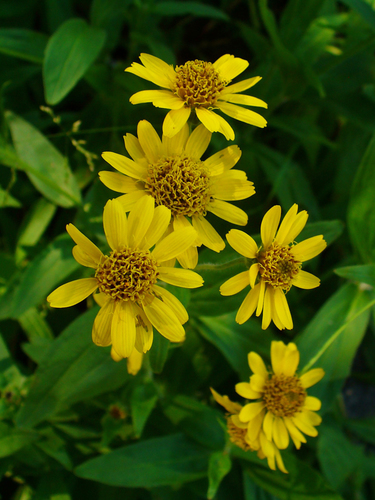
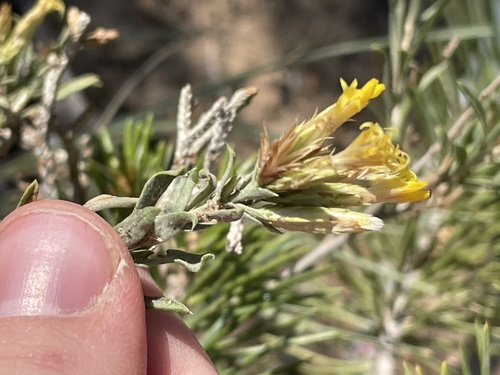
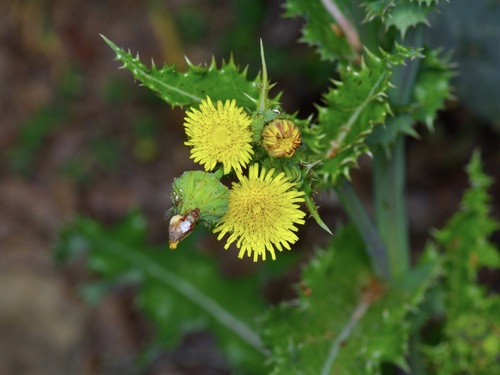
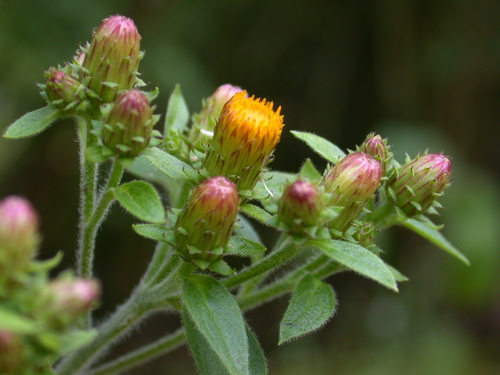
The inflorescence is a loose corymbose panicle of flower heads (capitula) borne on long stalks. Each flower head has multiple rows of purple outer bracts (phyllaries) surrounding a dense cluster of tiny yellow central flowers.
Outer Flower Features
The outer flowers are female, have 3 lobes with slightly elongated rays (ligules) reaching around 9 mm long, and a forked style.
Inner Flower Features
The inner flowers are 7 mm long with 5 lobes, are bisexual, and have 5 fused stamens plus a forked style.
Fruit and Pappus
The fruit is a 2 mm long achene topped with a pappus of white 8 mm long hairs.
Identification Challenge
When flowering, ploughman's spikenard is easy to identify, but its basal leaves strongly resemble the leaves of foxglove. Though the two species do not grow in the same location, correctly identifying non-flowering individuals can still be difficult.
Distinguishing Traits
Ploughman's spikenard can be distinguished by its softly hairy leaves that usually have smooth, untoothed margins (or occasional teeth tipped with a prominent hydathode), and its distinct fragrance, at least in spring and summer.
Native and Introduced Range
Ploughman's spikenard is native to Europe, Western Asia, and North Africa, and has been introduced to Colombia and New Zealand.
Conservation Status
It has not been evaluated for the IUCN Red List, but in Britain it is classified as 'least concern' because it is quite common and not threatened.
Axiophyte Significance
In many parts of Britain, it is classified as an axiophyte, meaning its presence indicates an area has favourable conservation status. As such, it is often counted towards site designation for wildlife sites, nature reserves and similar areas, and used to monitor the condition of these sites.
Soil Requirements
It only grows on calcareous soils formed over chalk, limestone, or sand.
Habitat Preferences
It prefers very short vegetation swards and often grows in disturbed areas such as roadsides and old quarries. It is rarely abundant, and usually occurs as scattered individual plants.
British NVC Classification
In the British National Vegetation Classification, it is found in calcicolous grasslands CG1, CG2, CG3, CG4, CG5, and CG7.
Associated Organisms
Ploughman's spikenard hosts a variety of flying insect pollinators and at least 48 parasites.
Specific Parasite Species
These include oxtongue broomrape, a species that is very rare in Britain but more common in Europe; the spikenard case-bearer moth, which is oligophagous feeding on this plant and related fleabanes; and Coleosporium inulae, a rust fungus that completes part of its life cycle on pine trees and part on members of the daisy family (Asteraceae).
Common Name Origin
Dried and powdered ploughman's spikenard root makes a pungent incense, and this is likely the origin of its common name ploughman's (comparable to poor man's) spikenard, even though its scent is not similar to true spikenard.
Traditional Uses
Dried leaves of the plant are also said to be burned and used as an insecticide and parasiticide, especially for killing fleas.