About Pentanema hirtum (L.) D.Gut.Larr., Santos-Vicente, Anderb., E.Rico & M.M.Mart.Ort.
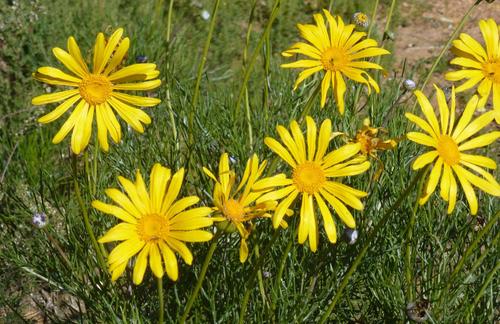
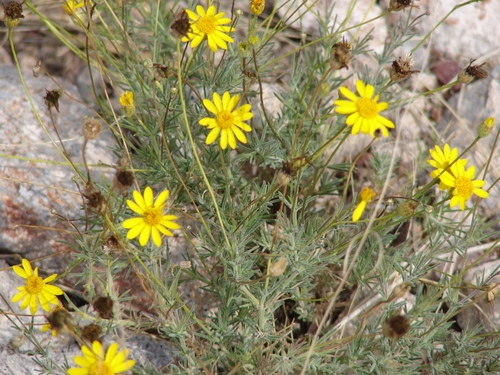
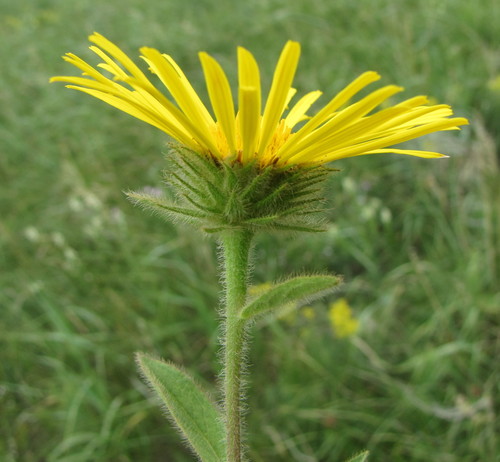
Pentanema hirtum grows to a height of 20–40 centimetres (7.9–15.7 in). It has an ascending, simple unbranched, cylindrical stem, with a striped, hairy surface. The entire plant is covered in stiff, light-colored hairs that are almost bristly. The underground structure is a moderately sized, oblique, light-colored rhizome, which averages 2 millimetres (0.079 in) wide and 25 millimetres (0.98 in) long. All cauline (stem-growing) leaves are alternately arranged, irregularly toothed, erect, tomentose on both sides, and hairy along the edges. They are typically flat, leathery, and rough, with a rounded base and obtuse apex, averaging 40–50 millimetres (1.6–2.0 in) long and 15–20 millimetres (0.59–0.79 in) wide. Lower leaves are elliptical or elliptical-lanceolate in shape, with a thin petiole, and are roughly the same size as the cauline leaves. Upper leaves are sessile, amplexicaul (their base wraps around the stem), and more distinctly lanceolate. The flowers of Pentanema hirtum are hermaphroditic. Outer flowers are ligulate, bright yellow, and functionally female, while inner flowers are tubular, dark yellow, and bisexual. Flower heads measure 35–50 millimetres (1.4–2.0 in) in diameter, and the flowering season runs from May through late September. The fruits are glabrous achenes with hairy appendages called pappus. This species is distributed across the Alps, Vosges, Jura Mountains, Pyrenees, Carpathian Mountains, Dinaric Alps, and Balkan Mountains. On the European plains, it is widespread in southern France, and extends across the Balkan Peninsula to the Caucasus and southern Russia. It prefers dry meadows and pastures in hilly and mountainous areas, and can be found at elevations up to 1,500 metres (4,900 ft) above sea level.