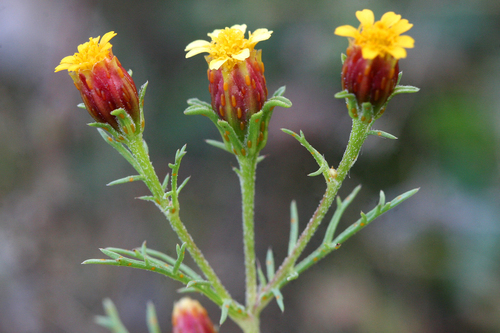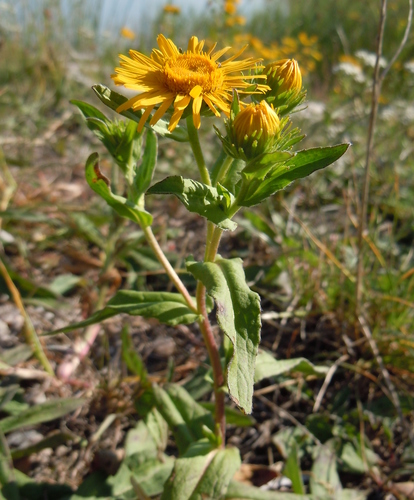
About Pentanema britannicum (L.) D.Gut.Larr., Santos-Vicente, Anderb., E.Rico & M.M.Mart.Ort.
This section covers the invasive characteristics, origin and distribution, modes of spread, and medicinal uses of Pentanema britannicum (also referred to as Pentanema britannica here).
As an invasive species, observations of Pentanema britannica in new habitats show it can thrive across a wide range of temperatures and climates, as evidenced by its presence in Sweden and eastern North America respectively. Moisture is a key limiting and influential factor for successful establishment of this species in new habitats: higher moisture levels correlate with greater invasibility. It is suspected that the species was introduced without its natural enemies, a factor speculated to contribute to its success as an invader. In both its native and new ranges, Pentanema britannica infests nursery crops, specifically hostas (plantain lilies) in the Netherlands. Its roots and rhizomes become intertwined with hosta root systems, and root fragments can become lodged under hosta bulb scales. Once intertwined, the species is aggressive, difficult to remove, and can persist even after washing infested hosta roots. By infesting hostas, it blocks the plants from accessing important nutrients from the soil. It is considered a threat to invaded environments, with potential to harm invaded plant ecosystems and cause loss of native plant life. It also poses a large economic risk due to the broad range of habitats it can invade and the environmental damage it can cause.
Pentanema britannica is native to Europe and Asia. It was first recorded in North America after introduction to Ontario, Canada in 1928, and was observed on Long Island, New York before 1915. After its arrival in New York, it was introduced to Michigan in 1990, Oregon in 2002, and Minnesota in 2004. Its current distribution is extensive, covering many countries across multiple continents. In Europe, it is found in Albania, Austria, Belgium, Bulgaria, Czech Republic, Slovakia, Denmark, Finland, France, Germany, Greece, Hungary, Italy, Luxembourg, Netherlands, Norway, Poland, Romania, multiple regions of Russia/USSR (Northern, Baltic, Central, Southwestern, Crimea, Southeastern), Spain, Sweden, Switzerland, the European part of Turkey, and Yugoslavia. In Asia, it occurs in northern and northeastern China, Korea, Iran, Armenia, Kurdistan, Dzhyuungaria-Kashgaria, Mongolia, multiple regions of USSR (Eastern Siberia, Far East, Soviet Central Asia), and the Japanese islands of Hokkaido, Honshu, Shikoku, and Kyushu. In North America, it is present in the Canadian provinces of Ontario and Quebec, and the U.S. states of New York, Michigan, Minnesota, and Oregon.
Several pathways are responsible for the spread of Pentanema britannica: contaminated plant material (especially hostas), wind, and local movement on nursery machinery. For example, the species was found in a west Michigan nursery in November 1999 after being accidentally imported with Dutch hosta plants, and it proved difficult to control. Additionally, because the species has documented medicinal uses, it may be transported by humans in passenger baggage.
In Chinese herbalism, Pentanema britannica is used by harvesting and drying its flowers. It has been used to treat sputum, as it was found to help when phlegm accumulates in the bronchi. It has also been used as a remedy for nausea, vomiting, hiccups, and flatulence. The plant part used depends on the severity of symptoms: mild conditions use the leaves, while more severe cases use the flowers. Multiple chemical constituents have been isolated from Pentanema britannica, including steroids, terpenoids, phenolics, and flavonoids. Most of these compounds are found in the flowers, and they have been found to have anticancer, antioxidant, anti-inflammatory, neuroprotective, and hepatoprotective properties. Pentanema britannica has pharmacological potential.