About Pentagramma triangularis (Kaulf.) Yatsk., Windham & Wollenw.
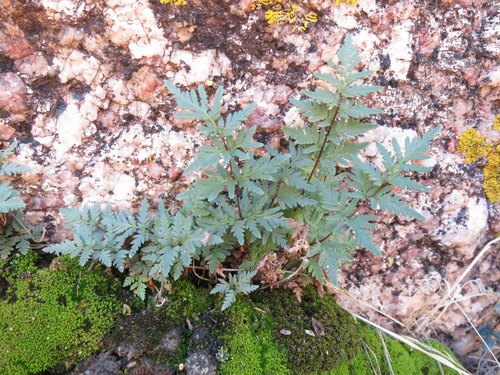
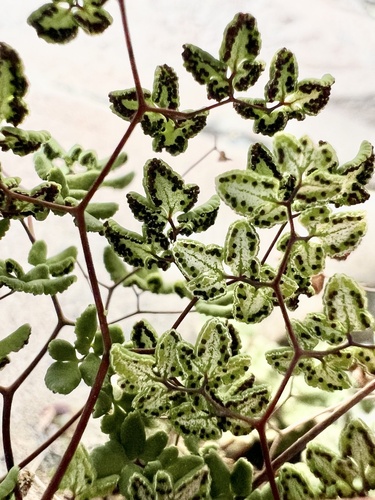
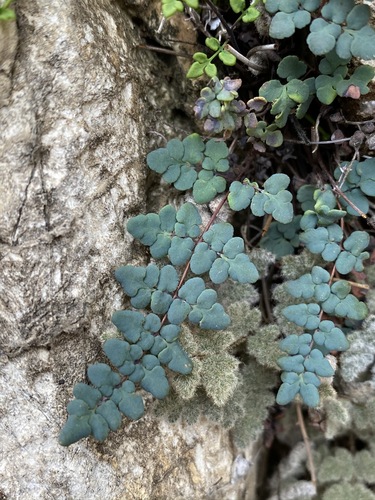
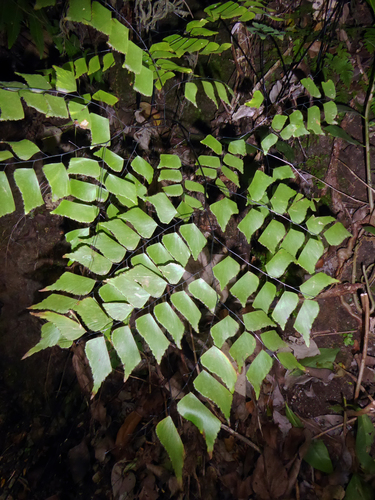
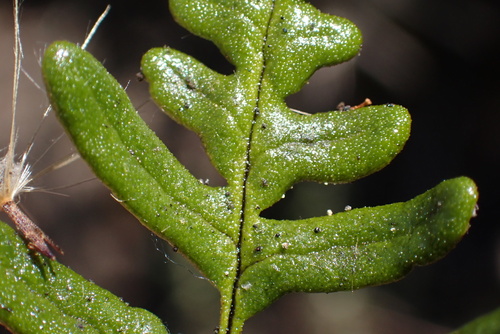
Pentagramma triangularis (Kaulf.) Yatsk., Windham & Wollenw. is a fern species that does not produce flowers or seeds, reproducing only by spores. It has long, smooth petioles (frond stems) ranging in color from black to brown. Its fronds are bright to dark green on the upper surface; the lower leaf surface holds dark spore sacs called sporangia, which are surrounded by a lighter yellow excreted powdery substance. This fern grows to a height of 6 to 12 inches. Like other species in the Pentagramma genus, it has characteristic asymmetry in its basal pinna: the basal secondary pinna on one side is 2 to 6 times longer than the one on the opposite side. When exposed to dry conditions, its leaves curl up with the spore-bearing lower side facing outward, which is thought to help conserve water. The distribution of P. triangularis covers most of the west coast of North America, ranging from Vancouver Island, British Columbia, to Baja California, Mexico, east to Arizona, and into the Blue Mountains of southeastern Washington. It also grows on Guadalupe, the Pacific island off the shore of Baja California; plants from this location may belong to an as-yet undescribed taxon. In California, P. triangularis prefers shaded areas and is most commonly found in rocky crevices and on north-facing slopes within mixed evergreen and oak forests, and it occasionally grows on dry brushy slopes. In more northerly locations, including British Columbia and Washington State west of the Cascade Range, it can grow in part shade or full sun, and it is mostly found on rocky outcrops. It occurs at elevations from sea level up to 8,500 ft (2591 m). Fronds of this fern are eaten by species such as the Dusky-footed woodrat. California Indigenous tribes used this goldback fern as an analgesic pain treatment: the Karuk tribe used it to treat pain related to childbirth, the Miwok tribe used it to treat toothaches, and Yurok children used the fern's golden powder to create body art.