About Pentaglottis sempervirens (L.) Tausch ex L.H.Bailey
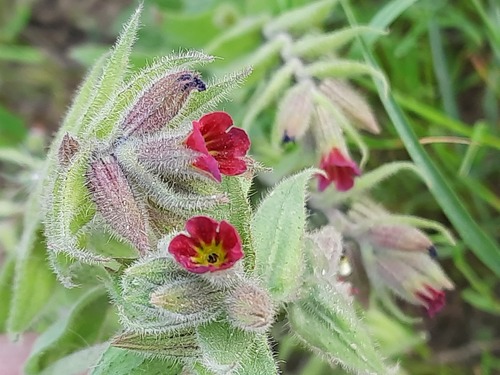
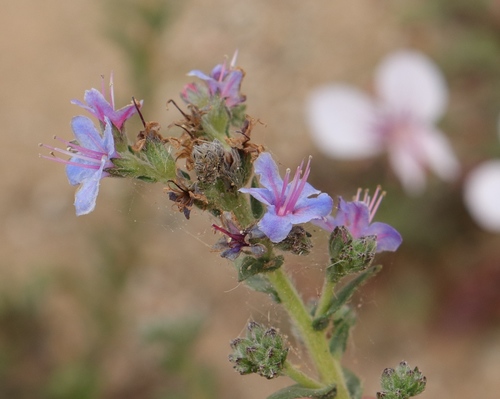
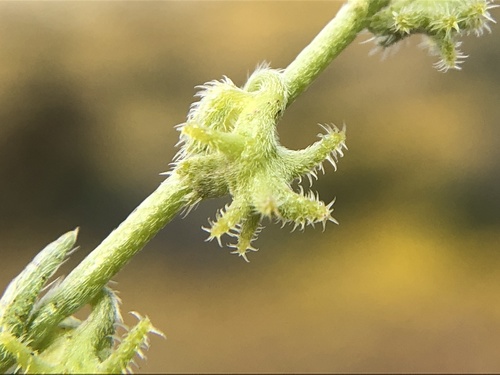
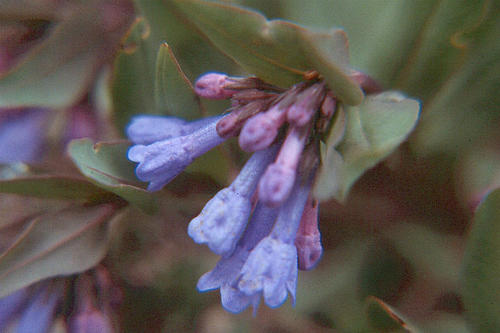
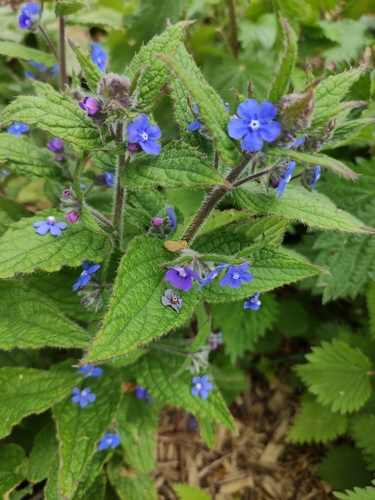
Pentaglottis sempervirens, commonly known as green alkanet, is a perennial plant with a deep tap root. It reaches a height of roughly 60–90 cm (23.6–35.4 in), and its stems are covered in coarse hair. Its leaves are broadly ovate to pointed oval; lower leaves grow on leaf stalks. Both the stem and leaves can cause skin irritation upon contact. This plant holds onto its green leaves throughout the winter. Green alkanet blooms in spring and summer while soil remains moist. It produces pink flower buds that open into bright blue flowers with white centers, each about 10 mm (0.4 in) wide. There are 5 sepals per flower, and flowers grow in clusters, with only one flower open at a time. Its stamens are hidden inside narrow floral tubes that end in the central white eye of the blue flower. Flowers are pollinated by bees and bumblebees. Seed capsules can travel short distances by catching on the fur of passing animals or human clothing. The native range of this genus is southwestern Europe, and the species is endemic to France, Portugal, and Spain. It has been introduced to Tasmania (Australia), Belgium, British Columbia (Canada), Czechoslovakia, Great Britain, Ireland, Italy, and the US states of California, Maine, Oregon, and Washington. It is an introduced species in the British Isles. It grows in woods, hedge-banks, damp shaded areas, and often grows near buildings. It prefers alkaline soils, and is classified as a weed in parts of the United Kingdom. The blue flowers of green alkanet are edible, and are commonly used as a garnish for salads and drinks. The roots are not edible: they contain pyrrolizidine alkaloids, which are toxic to the liver even after cooking. Although toxic when eaten in large quantities, the leaves have been used for medicinal purposes. Herbalist Nicholas Culpeper recommended leaves to treat coughs, digestive issues, and fevers. Crushed leaves mixed with vinegar and rose water work as an external remedy for burns and ulcers. In modern times, doctors have used the leaves and stems to treat staphylococcus infections.