About Pentachondra pumila (J.R. & G.Forst.) R.Br.
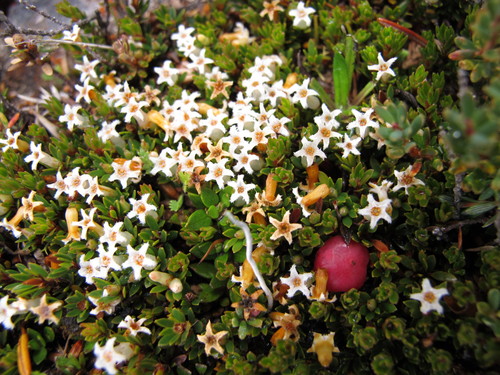
Pentachondra pumila (J.R. & G.Forst.) R.Br. is a prostrate shrub that reaches up to 10 cm in height and 40 cm in diameter. Its branches are pubescent, or occasionally glabrous. Leaves grow crowded near the ends of branches, and are oblong to elliptical in shape, measuring 3–5 mm long and 1–2 mm wide. The leaves are leathery and bluntly keeled, with 5-7 veins on the lower surface, and their margins are ciliate. Flowering occurs from November through to February. Small, white flowers are solitary on or near the ends of branches, are sessile, and usually face upright. Flowers are hermaphrodite, with petals fused to form a tube 5 mm long. The upper side of the petals is densely hairy, and hair density becomes sparser inside the corolla tube. Five anthers are fused to the petals, with a short style that protrudes from the centre, reaching 1.5 mm in height. Fruiting occurs from December through to April. The fruit is green through the winter months, becoming a fleshy red drupe upon ripening in the summer. It is separated into distinct pyrenes, and the style remains after the flower dies. P. pumila occurs in areas above the treeline, in cushion bogs, open snow tussock grasslands, and herbfields in Australia (Tasmania, Victoria, and New South Wales) and New Zealand (North, South, and Stewart Island). It is widely distributed through both countries in the regions mentioned above, though it is less common in the North Island of New Zealand and New South Wales in Australia. It frequently grows in exposed, rocky sites or in poorly drained, peaty areas, and is commonly found on the nests of ants of the genus Ochetellus. It is often confused with Cyathodes dealbata, which has a similar appearance and growth habit. P. pumila can be distinguished from this species because C. dealbata has glaucous veins on the underside of its leaves, which are not present on P. pumila. Most P. pumila flowers undergo self-pollination, with pollen falling from the anthers into the corolla tube. Despite how common this process is, the species has a high degree of self-sterility to prevent intense inbreeding. Self-pollination only produces a small number of fruits, and the fruits that do develop contain a reduced number of seeds. In contrast, cross pollination produces high numbers of fruits. Although P. pumila flowers are hermaphrodites, their anthers, short stigma, sticky pollen, and nectar that resides at the bottom of the corolla tube suggest that insect pollination is the main method of cross pollination between flowers, both on the same plant and on other nearby plants. For cultivation, P. pumila requires open, sunny positions in areas with mild winters (temperatures no lower than -5 °C), and cool, moist summers. It needs high rainfall, as it is intolerant to drought. It prefers gritty, peaty soil and rocky ground for establishment.