About Penstemon utahensis Eastw.
Utah penstemon (Penstemon utahensis Eastw.) is a herbaceous plant. Its stems grow either straight upward, or grow outward a short distance before curving upward, reaching heights between 15 and 50 centimeters. All stems are hairless, glaucous, and covered in natural waxes that give them a gray or blue cast, and they often also have a reddish tint. Similar to other penstemon species, immature growing tips may be curved. Each plant usually produces a few stems that grow from a branched, woody caudex.
The plant has thick leaves that are described as leathery or fleshy in texture, and are often folded lengthwise. It has well-developed basal leaves that grow directly from the base of the plant, as well as cauline leaves attached to the stems. The leaves do not have teeth, but sometimes have rough hairs along their edges or other leaf surfaces, though they can also be hairless. Basal leaves and the lowest leaves on stems are 3.5 to 10 cm long and 0.5 to 2 cm wide, and are usually less than 8 cm long. They are oblanceolate, shaped like a reversed spear head with the widest part above the midpoint.
Two to four pairs of leaves attach to opposite sides of the stems. Upper leaves are sessile, attaching directly to the stems without a petiole. They are 1.5–7.5 cm long and just 4–26 millimeters wide, and are normally elliptic to lanceolate in shape, though occasionally egg-shaped. The tip of the leaf tapers to a narrow point.
The inflorescence makes up the top 11 to 25 cm of each stem. It holds three to fifteen groups of flowers, though more than eleven is unusual. Each flower group usually contains two somewhat separated flowers, though this arrangement varies. Each group has two sub-groups of flowers called cymes, which usually have one to three flowers, but sometimes as many as five flowers attached to one point. The flowers are more or less secund, facing in a single direction away from the stem.
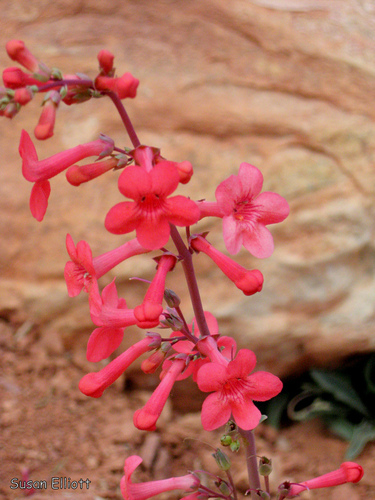
Utah penstemon flowers are most often true red to crimson; rarely they can be deep pink or pink-purple. They are tubular-salverform, with a narrow tube that opens to petal-like lobes. The five widely spreading lobes are nearly equal in size, and the flowers are only slightly bilabiate (two-lipped). Instead of the flower face being completely perpendicular to the tube, the lower lobes project slightly forward and the upper lobes are pushed slightly backwards. A forward-pointing lower lip normally acts as a landing platform for insects, so retaining this feature in a hummingbird-pollinated red penstemon is unusual. The overall corolla measures 17 to 25 mm, and is rarely longer than 22 mm. The outside of the flowers is covered in glandular hairs, especially toward the ends, and glandular hairs are also found on the insides of the floral tubes. Flowers do not hang downwards from the stems, and instead project out at nearly right angles to the stem. The stamens and the infertile staminode do not extend out of the flower's mouth. The staminode is 7–10 mm long and usually hairless, but may be covered in yellow papillate, nipple-like, hairs toward its end.
In its native habitat, the blooming season can start as early as April and may be as late as June. The fruit is a capsule 7–10 mm long and 5–7 mm wide. The seeds measure just 3–3.5 mm.
Utah penstemon is native to five western United States: California, Arizona, Nevada, Utah, and Colorado. Within these states, it grows largely in the Colorado River basin, extending into the deserts of southern California only as far west as the Kingston Range and New York Mountains. In Arizona, it can be found in Mohave, Coconino, and Navajo counties. In the Grand Canyon it grows at higher elevations from the Supai Formation up to the rim. It is also recorded in the three southern counties of Nevada: Nye, Lincoln, and Clark. To the east it grows in southwest Utah and throughout the Canyon Lands into western Colorado. In Colorado, the only records of this plant are near the border with Utah in Mesa and Montezuma counties. It grows at elevations of 400–2,500 meters (1,300–8,200 ft). It can be found growing in sagebrush steppes, pinyon–juniper woodlands, blackbrush scrub, desert scrublands, and in areas with only junipers. It is often associated with soils derived from sandstone.
Among penstemon enthusiasts, this species has a reputation for being difficult to maintain in gardens, though it is valued for its showy red flowers. Its seeds require eight weeks of cool, moist stratification to sprout.