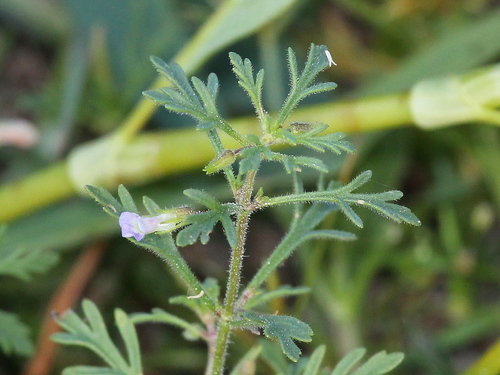
About Penstemon barbatus (Cav.) Roth
Stem Growth Form
Penstemon barbatus (Cav.) Roth most commonly has upright growing stems, though occasionally stems grow outward from the plant's base for a short distance before curving upward. Plants grow between 30 and 100 centimeters (1.0 to 3.3 ft) tall, and may produce either one or multiple flowering stems.
Leaf Surface Texture
Leaf surfaces vary: they may be smooth, partially covered in fine short hairs, or uniformly covered in fine short hairs. Some plants have hairless (glabrous) upper leaf surfaces, while their leaf undersides are covered in fine short hairs.
Basal Leaf Size
Basal leaves (growing directly from the plant's base) and lower stem leaves range from 3 to 14 centimeters (1.2 to 5.5 in) in length, most often less than 8 cm (3.1 in). Their width ranges from 6 mm to 35 mm, and is usually between 12 and 30 mm.
Basal Leaf Shape
These leaves have an oblanceolate shape (wider past the middle with a tapered base, resembling a reversed spear head) and attach to the plant via leaf stems called petioles.
Upper Cauline Leaf Shape
Upper cauline leaves (attached higher on the stem) are narrowly lanceolate (shaped like a thin spear head) or linear (long and narrow like a blade of grass).
Upper Cauline Leaf Size
They measure 28 to 142 mm (1.1 to 5.6 in) long and 1 to 15 mm wide, most often less than 8 mm wide.
Upper Cauline Leaf Attachment
These leaves have tapered bases that attach directly to the stem, and their tips are long and drawn out (acuminate) or at least narrowly pointed.
Inflorescence Structure
The inflorescence holds 6 to 19 groups of flowers; each group has a pair of bracts beneath the point where flower stalks (peduncles) attach to the main stem. Each group contains two cymes (flower subgroup attachment points), one on each opposite side of the main stem, and each cyme holds 1 to 4 flowers, most often at least two.
Flower Appearance
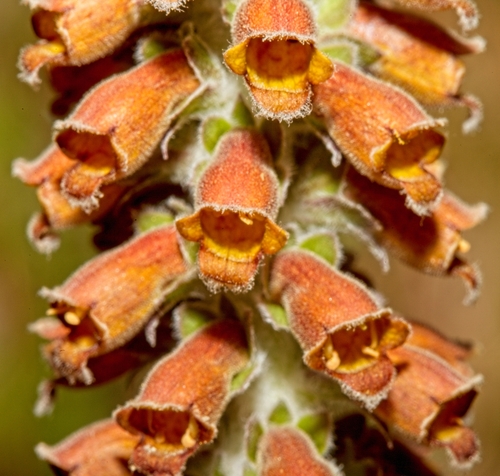
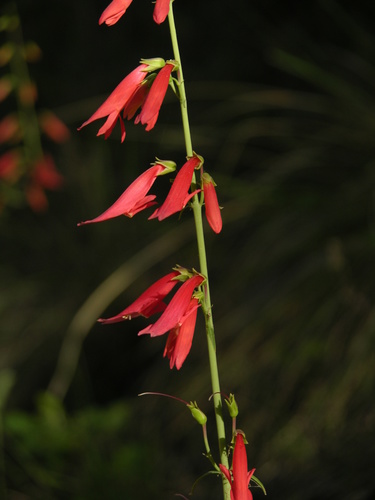
The flowers are narrow tubes in bright scarlet, orange-red, or crimson; they are smooth on the outside and lined with white to golden hairs inside the tube. Flowers measure 26 to 36 millimeters (1.0 to 1.4 in) in length.
US Distribution Range
Penstemon barbatus grows in the Four Corners states, Texas, and across much of Mexico. In Colorado, it grows mainly in southern mountain counties, and is found no further north than Garfield County. In Utah, its native range does not extend as far north, only reaching Wayne and San Juan counties.
South Central US Distribution
In New Mexico, the species is absent only from the southeastern quarter of the state, and it grows across most of Arizona. In Texas, P. barbatus is mostly found in counties of the Big Bend region and in the far northwestern part of the state.
Northern Mexico Distribution
This species is very common in northern Mexico. In northwestern Mexico, it grows in two of the four northwestern states: Sinaloa and Sonora. In northeastern Mexico, it grows in every state, including Aguascalientes, Chihuahua, Coahuila, Durango, Guanajuato, Hidalgo, Nuevo León, Querétaro, San Luis Potosí, and Tamaulipas.
Central Mexico Distribution
In the central Mexican highlands, it grows in Mexico City, the State of Mexico, and three additional states: Morelos, Puebla, and Tlaxcala. It also grows in the Gulf coast state of Veracruz.
Southern Mexico Distribution
It is far less widespread in southern Mexico, where it has only been reported in Chiapas in the southeast, and in Jalisco, Michoacán, and Oaxaca in the southwest.
Variety barbatus Habitat
Variety barbatus is associated with piñon–juniper woodlands, ponderosa pine forests, and Douglas-fir forests in the southern parts of these vegetation types' ranges, alongside Gambel oak. It typically grows at elevations of 1,200 to 3,000 meters (3,900 to 9,800 ft), and occasionally grows as high as 3,400 meters (11,200 ft).
Variety torreyi Habitat
Variety torreyi is associated with all of these habitats except piñon–juniper woodlands; it additionally grows in spruce-fir woodland and montane meadows at elevations of 1,800 to 3,200 meters (5,900 to 10,500 ft).
Variety trichander Habitat
Variety trichander only grows in piñon–juniper woodlands and birch-maple woodlands at elevations of 1,600 to 2,200 meters (5,200 to 7,200 ft).
Traditional Use
The Zuni people rub the chewed root of the torreyi subspecies of Penstemon barbatus over rabbit sticks to improve chances of hunting success.