About Penstemon albidus Nutt.
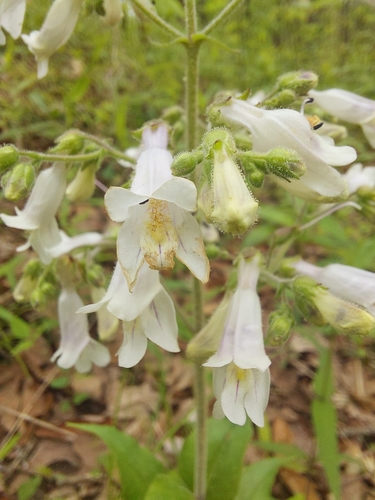
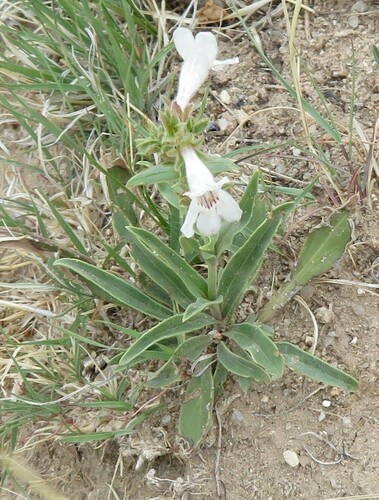
Penstemon albidus Nutt. is a long-lived herbaceous plant that most often blooms from April to June. Its upright flowering stems reach 8–60 cm in height, and are more typically 15–50 cm tall, with only a slight curve at the base. Stems are covered in extremely fine, short hairs, becoming more glandular and hairy closer to flower buds and flowers. Plants may grow either one or multiple flowering stems. Basal leaves attach to the plant base via short stems, and range in shape from lanceolate to obovate. They are usually 20–90 mm long and 7–20 mm wide, though they occasionally reach 110 mm in length or narrow to 4 mm. Leaf texture varies from smooth to quite rough and scabrous with short, tough hairs, but leaves are never leathery. Leaf edges also vary between plants, from smooth through slightly serrate to distinctly serrate. Flowering stems bear 2–6 leaves that are similar in shape to basal leaves, and grow in opposite pairs. They tend to be shorter, measuring 25–65 mm long and 3–21 mm wide, and clasp the flowering stem instead of growing on short leaf stems; this clasping is especially noticeable on the upper leaves of the flowering stem. Leaves and flowering stems grow from a short, branched, persistent stem called a caudex. Underground, Penstemon albidus has a taproot with fibrous lateral roots. If above-ground parts are damaged, the plant produces new regrowth shoots from the crown. The inflorescence is a thyrse with flowers blooming in succession from bottom to top as it grows. The flowering portion is 4–25 cm long, and occasionally reaches 30 cm. Flowering stems have a cylindrical cross-section and are densely glandular-pubescent. There are 2–10 groups of flowers (verticillasters) on short stems that attach to the main stem. Closer inspection shows each stem group is subdivided into a pair of attachment points, each holding 2–7 flowers. The bracts near each flowering group are pointed, narrow, and lanceolate, 17–65 mm long and 3–17 mm wide. The short pedicels supporting each flower, as well as the peduncles, are densely glandular and hairy, just like the main flowering stem. The sepals (calyx lobes) of Penstemon albidus flowers are 4–7 mm long, 1.5–3 mm wide, pointed, and covered in glandular hairs. The flower is white, and occasionally tinged with delicate shades of lavender, blue, or pink, possibly due to crossbreeding with other species. Flowers often have red or magenta nectar guides that extend from the flower mouth down the lower interior of the flower tube toward the back, and these guides are often quite dark in contrast to the rest of the flower. The overall flower shape is a funnel 12–20 mm in length and 6–8 mm in diameter. The flower tube is not constricted at the opening, measures 4–6 mm long and 6–8 mm in diameter, and is glandular pubescent internally. In sunlight, the edges of the flowers glisten slightly because of their numerous hairs. P. albidus tends to produce larger flowers in the northern part of its range than in the southern part. Stamens remain held within the flower tube and have black, flattened, spread-out anther sacs. Each pollen sac is 0.1–1.1 mm in size and opens completely. The staminode is 8–9 mm long, does not extend beyond the flower throat, and is sparsely to moderately covered in 1 mm long shaggy yellow hairs near its end, close to the flower mouth. The staminode may be either straight or recurved. The style is generally 9–11 mm long, and occasionally reaches 13 mm. Depending on altitude and weather conditions, flowering lasts 16 to 42 days, starting between April and the end of July, and rarely extends as late as September. Botanist Francis Pennell noted that the flowers are very fragrant at dusk, when they are visited by moths. The seed capsules are small, drop-shaped, about 8–12 mm long and 4–7 mm in diameter. The seeds are black to dark brown and 2–3 mm in size. Penstemon albidus is commonly found growing in silty, sandy loam, or gravelly soils, at elevations from 300 to 1800 m. Its main habitat is open, dry prairies, but it also grows in juniper savannas in Colorado. It is one of the most widely distributed members of its genus, native to almost the entirety of the western Great Plains of North America. In the southern part of its range, it grows in northern West Texas and the Texas Panhandle, northeastern New Mexico, and western Oklahoma including the Oklahoma Panhandle. Its range continues north into the western half of Kansas and the eastern plains of Colorado. The USDA Natural Resources Conservation Service PLANTS database records it throughout most of Nebraska and three of Iowa's westernmost counties. White penstemons grow in the western third of Wyoming, almost all of Montana including valleys in the state's mountain foothills, throughout North Dakota, much of South Dakota, and the western counties of Minnesota. In Canada, its natural range is restricted to the southern portions of Alberta, Manitoba, and Saskatchewan; Flora of North America considers reported occurrences in Ontario to be introductions. Above-ground growth of P. albidus is rarely eaten by grazing livestock. Its populations increase in grazed areas compared to ungrazed land, with the greatest increase occurring when areas are grazed intensively twice a season, rather than being constantly grazed. It is not competitive with other plants in dry prairies, does not form clumps, and does not invade new areas. It is generally restricted to relatively virgin prairie areas that have not been plowed or mowed, and is difficult to reestablish once removed from a landscape. P. albidus is also only rarely part of grasshopper diets: only Melanoplus confusus and Melanoplus foedus have been recorded feeding on it, 3% and 1% of the time respectively. Though it is a common flower within its range, it does not form uniform stands, and typically does not make up the majority of plants in an area. In cultivation, white penstemons are durable and long-lived under garden conditions, and produce a good show of flowers in early summer; however, their leaves are not noticeable or showy. It was one of the first penstemon seeds offered for sale in Europe by John Fraser in 1813, though it is not widely grown there in the 21st century. In garden settings, it is adapted to full sun and neutral to somewhat alkaline soils. It grows well in sandy loam, sand, or gravelly soils, and requires either largely dry soils or very well-drained conditions. Cultivation seed is collected between April and July when the seeds have darkened. Seeds require eight weeks of cold, moist stratification to sprout, or can be planted outside over the winter. The coldest USDA hardiness zone where this plant is known to survive is zone 3.