About Pennantia cunninghamii Miers
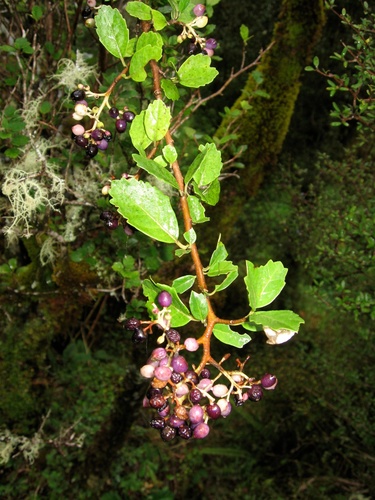
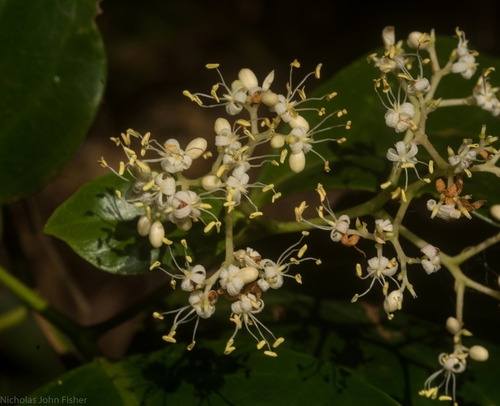
Pennantia cunninghamii, commonly known as brown beech, is a tree that typically reaches a maximum height of 30 metres (98 feet). Its trunk is irregularly fluted, with dark grey to brown, often scaly bark, and has a flanged base. Its leaves are elliptic or oblong, measuring 70–180 mm (2.8–7.1 in) long and 40–80 mm (1.6–3.1 in) wide, borne on a 10–20 mm (0.39–0.79 in) long petiole, and arranged along zig-zagging branchlets. Both sides of the leaves are glossy, with prominent domatia located on the veins. Flowers of this species are either bisexual or male, arranged in panicles at the ends of branches or in upper leaf axils. The sepals are not prominent, while the petals are glabrous, 3–4 mm (0.12–0.16 in) long and 1.0–1.5 mm (0.039–0.059 in) wide. Flowering occurs between November and January. The fruit is a fleshy black drupe, 10–15 mm (0.39–0.59 in) long and 7–9 mm (0.28–0.35 in) wide, containing a single seed. This tree grows in rainforest habitats, ranging from Clyde Mountain near Batemans Bay (35° S) in southern New South Wales to Atherton (17° S) in tropical Queensland. The fruit of Pennantia cunninghamii is eaten by the grey-headed flying fox and a range of bird species, including the brown cuckoo dove, green catbird, topknot pigeon, wompoo fruit-dove, and white-headed pigeon. Larvae of the moth Cardamyla carinentalis pupate between leaves of this tree species.