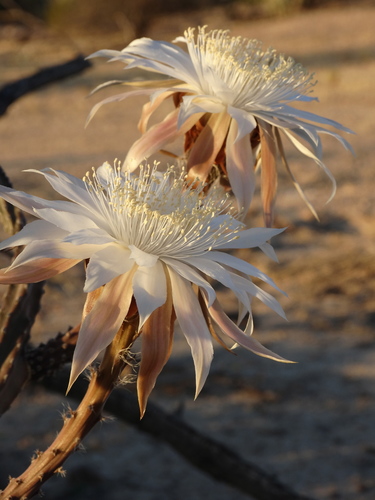
About Peniocereus greggii (Engelm.) Britton & Rose
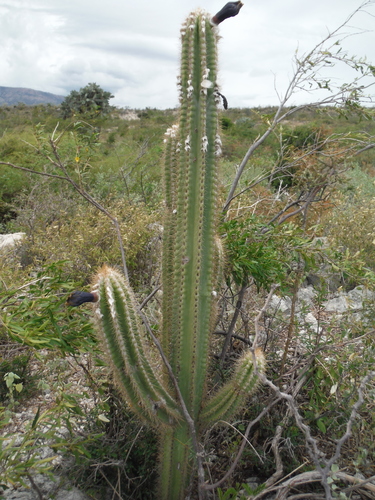
This cactus species grows as a branching shrub. Its stems are gray-green, roughly 1.2 centimeters wide and up to 3 meters long, with 6 to 9 distinct edges or wings. Areoles on the stems bear one 2-millimeter-long white central spine, plus 9 shorter dark radial spines that measure less than 1 millimeter each. The species produces white flowers that are 15 to 30 centimeters long and 5 to 7.5 centimeters in diameter, with a strong vanilla-like scent. The floral tube of each flower is covered in small spines. Flowers open after sundown, close and wilt within a few hours, and are completely gone by 9 am the following day. Plants typically bloom just one night per year, usually in June or July, and all individuals in a given area will bloom on the same night. Fruits are oval-shaped and 5 to 7.5 centimeters long. Peniocereus greggii develops a large underground tuber that has a mild potato-like flavor; this tuber can grow up to 60 centimeters (24 inches) in length and weigh as much as 57 kilograms (126 pounds). The diploid chromosome count for this species is 2n = 22. Tohono Chul, a botanical garden and museum located in Tucson, Arizona, holds the largest private collection of Sonoran Desert native night-blooming cereus (Peniocereus greggii). Each summer, the garden hosts "Bloom Night", a special event held on the single night predicted to have the maximum number of cereus flowers in bloom. The garden opens from 6pm until midnight for this event, allowing guests to walk the grounds and view the blooming flowers. This species is distributed across the southwestern United States and northern Mexico. In the United States, it occurs in Arizona, New Mexico (specifically in Dona Ana, Grant, Hidalgo, and Luna Counties), and the Big Bend Region of Texas. In Mexico, it is found in the states of Chihuahua, Coahuila, Durango, Sonora, and Zacatecas. It grows at elevations ranging from 300 to 1500 meters, and is common throughout the higher elevations of the Sonoran Desert surrounding Tucson. It typically grows in silty soil within desert scrub habitat, alongside associated species including Larrea divaricata and Neltuma glandulosa.