About Peltaria alliacea Jacq.
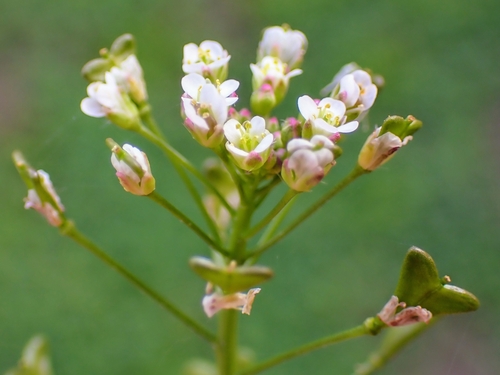
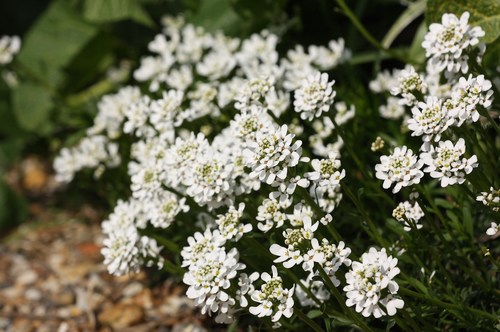
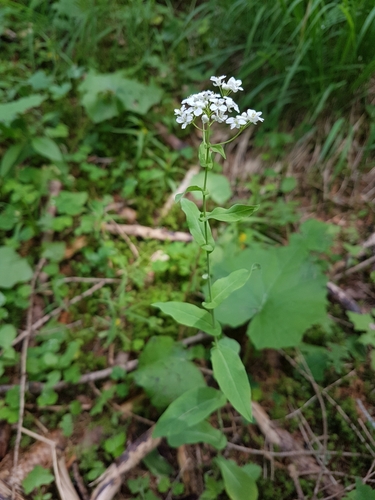
Peltaria alliacea, commonly called garlic cress, is a perennial flowering plant in the Brassicaceae family. It is native to Albania, Austria, Hungary, Romania, and the territory of former Yugoslavia. This plant reaches up to 60 cm (24 in) in height, and produces white flowers from May to July. It is completely glabrous, meaning hairless, with simple, entire leaves. The leaves are ovate in shape, sessile, and amplexicaule, with lobes that fully wrap around the stem. When crushed, the leaves release a garlic scent, which gives the species its common name. Its white petals measure 3–4 mm (0.12–0.16 in) in length and end in a short claw. It produces orbicular, very flat siliculas (seed pods) that are pendent and measure roughly 6 by 6 mm (0.24 by 0.24 in). Documented chromosome counts for this species are 2n=14, 28, and 56. It was first published and formally described by Nikolaus Joseph von Jacquin in 'Enum. Stirp. Vindob.' on page 260, in May 1762. It naturally grows in stony habitats ranging from southern Austria (Styria and Lower Austria) to southern Romania and Albania. It has become naturalized at one single location on the Isle of Skye in the United Kingdom. This species is also cultivated as an herb or vegetable. Its leaves are edible, and add a spicy flavor to salads, though they tend to turn bitter during the summer.