About Peltandra virginica (L.) Schott
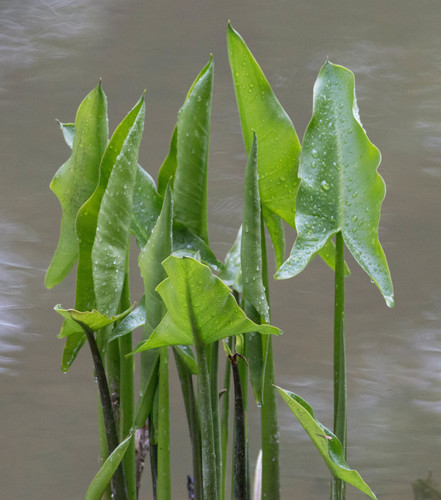
Peltandra virginica (L.) Schott is an emergent perennial aquatic herb that grows from a large perennial rhizome. Its roots and rhizome base embed in submerged wetland substrate, while leaves and inflorescences extend above the water surface. Individual leaves have petioles between 38 and 98 centimeters long, and leaf blades between 9 and 57 centimeters long; a single leaf can have a petiole nearly one meter long and a blade half a meter long. Leaf blades vary widely in shape, size, and lateral vein thickness even within small local populations, but are most commonly broadly arrowhead-shaped. Blades are medium green, while petioles may range from green to green-purple to solid purple. This species bears inflorescences 7 to 25 centimeters long, with a spadix that ranges from half the full length of the enclosing spathe to matching its full length. The spathe is generally pale green to white, and is lighter in color on its inner surface. Inflorescences hold male, female, and sterile flowers; flower color ranges from whitish to greenish to yellow. Pollination occurs via brood-site mutualism with the chloropid fly Elachiptera formosa. During the female pistillate stage, the spadix is fully enclosed by the spathe, blocking insect access to female flowers. When the inflorescence reaches the male staminate stage, male flowers produce an odor that attracts Elachiptera formosa flies. The flies feed on pollen, mate, find suitable oviposition sites here, and their larvae develop to maturity within the inflorescence. Fruits develop and ripen inside the closed spathe. Unripe fruits range from pea green to mottled green and purple, and measure 6 to 16 millimeters across. Mature fruits are brown berries that hold a small number of seeds inside a clear gelatinous pulp. Large quantities of these seeds can accumulate in the soil of wetlands. Across most of this species' range, flowering occurs from spring through late summer and fall; in warmer regions, flowering continues into winter. Peltandra virginica thrives in low salinity environments. It is native to North America. Its native range covers the entire eastern coast of the United States, extending west as far as Texas, and it is present in eastern Canada. It has also become naturalized in coastal areas from California north to Oregon. Outside its native range, it occurs as an introduced and often invasive plant in other parts of North America. Its primary habitat is wetlands, including swamps, marshes, ponds, and bogs. Non-reproductive structures of Peltandra virginica contain calcium oxalate crystals. These crystals can irritate the gastrointestinal system of humans and animals, and have been linked to the formation of kidney stones.