About Pelopidas conjuncta (Herrich-Schäffer, 1869)
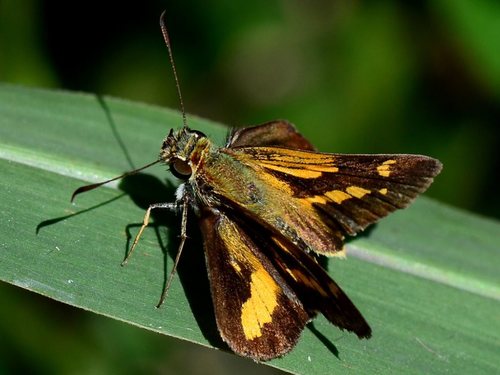
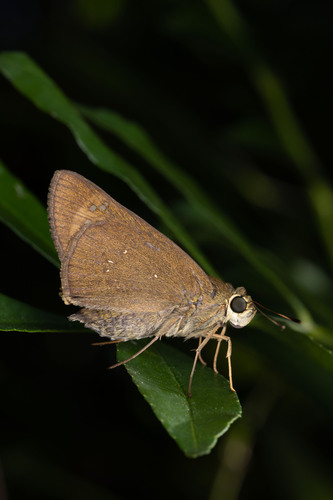
This is a description of Pelopidas conjuncta (Herrich-Schäffer, 1869), focused on male individuals. On the male’s upperside, the base color is dark olive-brown. The forewing has nine semi-diaphanous yellowish-white spots. Two of these spots sit towards the end of the cell, positioned one above the other, well-separated, and touching the cell margins. Three equal-sized small sub-apical spots form an outwardly oblique, well-curved line. The remaining spots sit in an inwardly oblique discal series, with one spot per interspace. The spot near the base of the first median interspace is the largest in the discal series, with its lower end extended outward. The spot above this largest spot is around half its size, and its outer lower end is also somewhat extended. The small upper spot is about the same size as the sub-apical spots, and there is an additional spot at the middle of the sub-median vein. The hindwing has two or three small discal spots, plus a white spot near the upper end of the cell. The cilia of the forewing are cinereous (ash-gray), while the cilia of the hindwing are whitish with a cinereous base. The underside of the wings is paler than the upperside. The forewing has the same spot pattern on the underside as it does on the upperside. The hindwing has a small white spot near the upper end of the cell, plus a discal series of small white spots. The antennae are black, with a pale red tip on the club. The underside of both the shaft and club is whitish, and the shaft is marked with black spots. The palpi, head, and body match the wing color. The underside of the palpi is whitish, the underside of the abdomen is covered in a whitish wash, and the legs are tinted dull red. Females match males in overall appearance, but the spots on the forewing are usually larger, which places them closer together, and the largest spot in the discal series is usually much larger than that of the male.