About Pelodytes punctatus (Daudin, 1802)
Species Identification
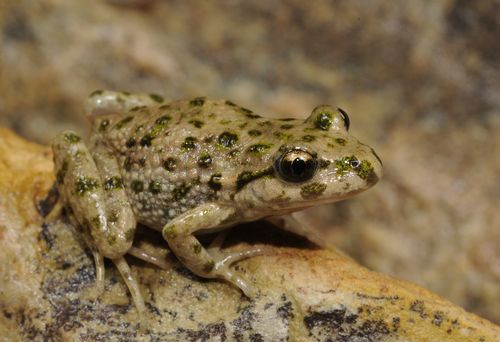
The common parsley frog, Pelodytes punctatus, is a very small, slender frog with long hind legs, a flat head, and vertical pupils.
Size
Males usually only reach 3.5 cm (1.4 in) in length, while females are typically larger at 3.9 cm (1.5 in).
Dorsal Coloration
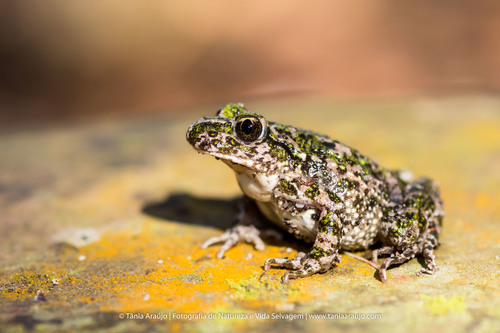
The dorsal (upper) side of its body varies in colour, and usually has irregular green patches over a light brown, grey, or light olive background.
Dorsal Skin Features
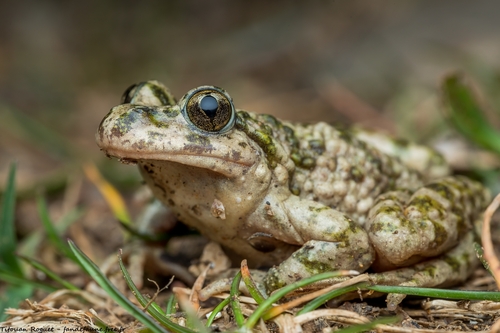
Its back is dotted with elongated warts, which often form undulating longitudinal rows that may be orange along the flanks.
Cranial Gland Features
A short small gland sits behind its protruding eyes and above the tympanum, and the species has no parotid glands.
Ventral Coloration
The underside of the frog is white, with yellow-orange colouring around the pelvis.
Fossorial Adaptations
Pelodytes punctatus is fossorial: its limbs are adapted for burying and digging to live underground.
Mating Season Male Morphology
During the mating season, males develop dark swellings on the insides of their digits and forelimbs, as well as on their chest. Males also generally have stronger forelimbs than females.
Camouflage
While not completely cryptic like many other frog species, common parsley frogs are still camouflaged in their native environments.
Jumping Ability
They can jump 50–70 cm (19.5–27.5 in) in a single leap, and this ability gives them the common name "Mud-Jumper", or "Modderkruiper" in Germany.
Geographic Distribution
Common parsley frogs are found in France, northeastern Spain, and a small area of northwestern Italy, specifically southern Piedmont and Liguria.
Population Trend
Their population is decreasing across their entire range, due to habitat changes that eliminate their breeding sites.
Regional Threat Levels
The species is also at greater risk of threat in southern Spain and northern Portugal.
Taxonomy Status
The taxonomy of the genus Pelodytes is currently under discussion, with ongoing disagreement caused by separated lineages, particularly in different contact zones within the Iberian Peninsula.
Elevation Range
Their habitats range from sea level up to middle mountainous elevations between 1,630–2,000 meters (5,350–6,560 feet) above sea level.
Preferred Breeding Elevation
While they can survive across this full elevation range, they prefer to breed at lower elevations, around 60–460 meters (200–1,510 feet) above sea level.
Activity Drivers
The habits of common parsley frogs vary between ecological niches, as their activity is heavily weather-dependent.
Population Variation in Breeding Timing
Because of their wide range and flexibility in egg-laying and mating habits, local populations may have different activity and breeding date ranges than other populations of the same species in areas with different weather patterns.
Metamorphosis Timing
Metamorphosis can occur as early as January or February, and can last until March, depending on the population's distribution range.
Phenotype Plasticity During Metamorphosis
During metamorphosis, common parsley frogs show phenotype plasticity, partially because their breeding habitats are unpredictable. This plasticity, which refers to developing different phenotypes to best adapt to a local environment, leads to different body sizes and other physiological changes among individuals of the species.
Pond Drying Effects on Larval Traits
Young frogs from shallower ponds that dry more quickly develop different phenotypic characteristics, and drier ponds produce shorter larval periods for the species.
Tadpole Morphology by Pond Type
Tadpoles that develop in ponds with consistent water depth tend to have larger body size, greater body depth, longer and deeper tails, and longer and deeper tail fins.
Survival Impact of Morphological Differences
These differences do not affect the survival rate of the frogs.
Post-Metamorphosis Size Trends
After metamorphosis into toadlets, this trend continues: frogs from drier ponds are smaller.
Potential Impacts of Size Differences
These size differences may affect other aspects of the frogs' lives, such as mating and fecundity.
Terrestrial Life Plasticity Effects
Other than the size differences noted, terrestrial life for common parsley frogs does not appear to be heavily impacted by these phenotypic changes.
Anuran Drying Response Prevalence
Many other anuran species show similar size and growth trends in relation to drying environments.
Plasticity Origin
However, the morphological changes and plasticity seen in common parsley frogs are notable, as these changes are confirmed to be mostly plastic rather than genetic or mutation-induced.