About Pelobates syriacus Boettger, 1889
Common Names and General Morphology
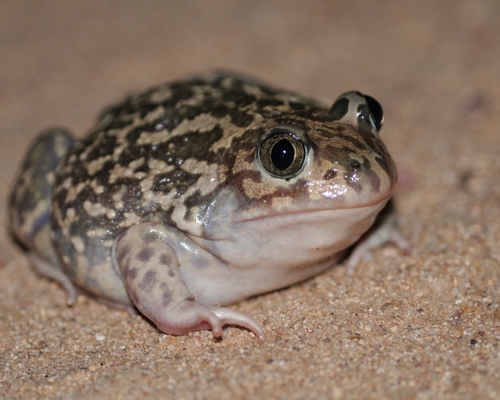
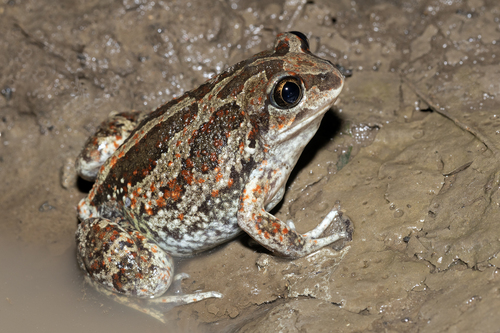
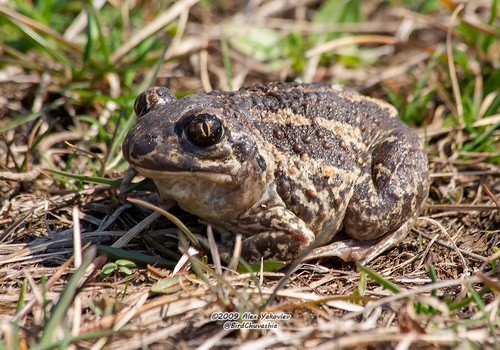
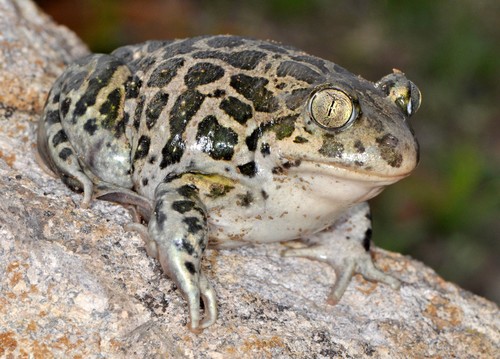
Pelobates syriacus, commonly called the eastern spadefoot, is a plump toad with a large head topped by a flat skull, large protruding eyes, and vertical slit-like pupils.
Adult Size
It reaches an adult length of approximately 9 centimetres (3.5 in).
Skin Texture
Its skin is smooth, with a scattering of small warts.
Male Breeding Gland
Males have a large gland at the back of their fore legs that becomes enlarged during the breeding season.
Limb and Foot Structure
Its front foot has four toes, while the back foot has five toes with deeply indented webbing between them. The hind legs are short, and at the back of each hind foot sits a yellowish bony protuberance called the inner metatarsal tubercle, or spade — the feature that gives the species its common name.
Body Coloration
The eastern spadefoot's body colour is quite variable; the back is often pale grey with large, irregular, greenish blotches, and the belly is pale grey.
Similar Species Distinction
It can be told apart from the western spadefoot (Pelobates cultripes) by the colour of its spade, which is black in the western spadefoot, and from the common spadefoot (Pelobates fuscus) by its non-domed head.
Native Distribution Range
The eastern spadefoot is native to Armenia, Azerbaijan, Bulgaria, Georgia, Greece, Iran, Israel, Lebanon, the Russian Federation, Syria, and Turkey.
Regional Population Status
It is quite common in Iran, but uncommon across most of its range. It is thought to be extinct in Jordan, and its conservation status is unclear in Iraq.
New Distribution Record
Research led by the Palestine Museum of Natural History has recorded this species in Wadi Qana, located in the West Bank.
Habitat Types
This toad lives in light woodland, shrubby bushy areas, semi-desert habitats, badlands, arable fields, and dunes.
Soil Preference
It prefers loose soil that it can dig into with its spades to create the burrows it lives in, though it is also found in rocky areas and pebbly clay soils.
Climatic Range Limitations
The species' range is limited by mean annual temperature and rainfall: it does not occur in areas with insufficient summer temperature or high rainfall levels. The northern edge of its distribution may also depend on the range of the common spadefoot.
Breeding Habitat Limitation
Because the eastern spadefoot produces large tadpoles, its distribution is also limited by the presence of sufficiently large, fish-free ponds.