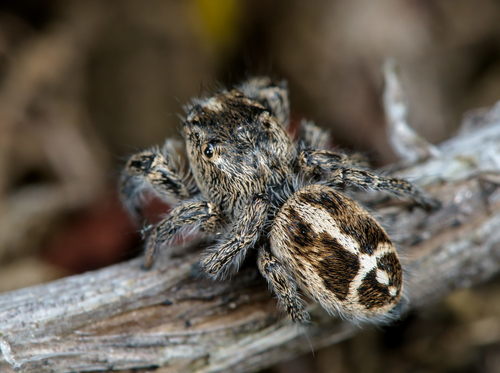
About Pellenes tripunctatus (Walckenaer, 1802)
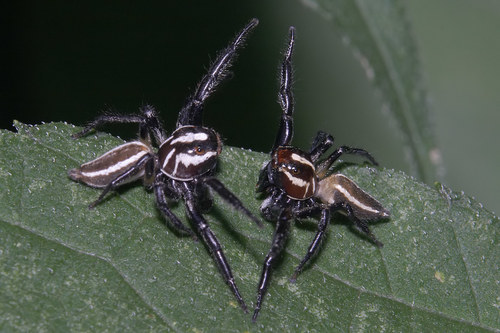
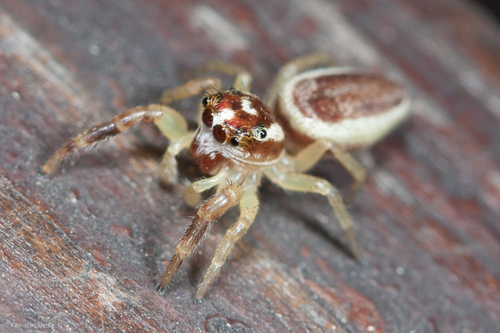
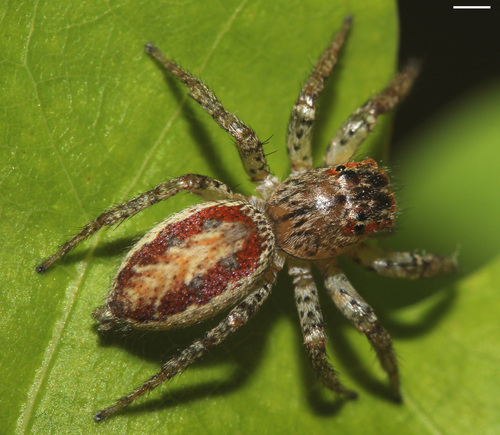
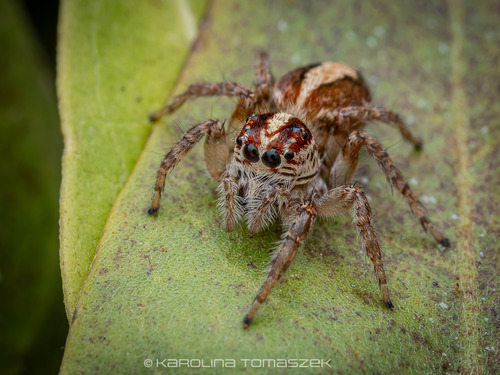
Pellenes tripunctatus (Walckenaer, 1802) shows clear sexual dimorphism in both size and coloration. Measurements from Chinese specimens note that females have a total body length of 7.2 mm, while males are smaller at 5.7 mm. This species is widely distributed across the Palearctic region, with confirmed records from Europe, the Caucasus, Central Asia, and China. In the British Isles, it has a restricted range, is considered rare, and has been recorded mostly from coastal shingle habitats in Kent and Dorset. Pellenes tripunctatus occurs in mountainous grassland areas. In Europe, C. L. Koch recorded that fully mature males develop in May and June. The species is commonly found on the ground or under stones, where it builds a soft, narrow but dense silken retreat. Observations from Germany also confirm the species constructs these same soft, narrow, dense silken retreats under stones, and maintains a typical body form while occupying its terrestrial microhabitats. Pellenes tripunctatus displays a distinct overwintering behavior: it regularly uses empty land snail shells as winter retreats. This overwintering behavior is also seen in the closely related species Pellenes nigrociliatus and Attulus penicillatus. Researchers have documented unusual aggregation behavior in this species, with up to six individuals (five females and one male) recorded overwintering together inside a single snail shell. This suggests potential social behavior, a trait that is uncommon among jumping spiders. The species uses snail shells not only for overwintering, but also for a range of other life activities including molting, mating, and egg-laying. Females prefer to occupy barren soil environments that contain fragments of herbs or grasses. In these locations, they can hang snail shells to use as sites for egg-laying, and as retreats for their offspring.