About Pellenes nigrociliatus (Simon, 1875)
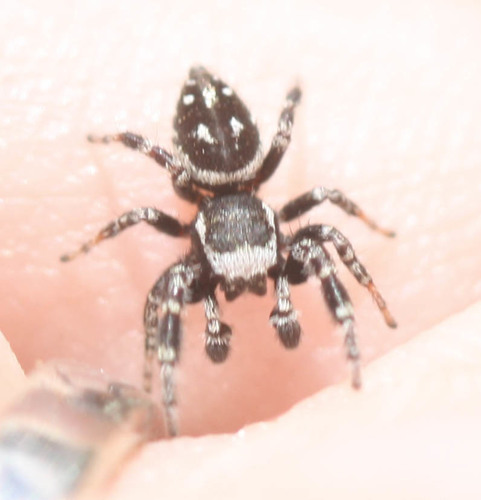
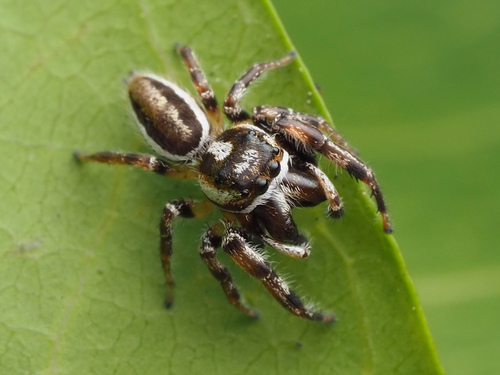
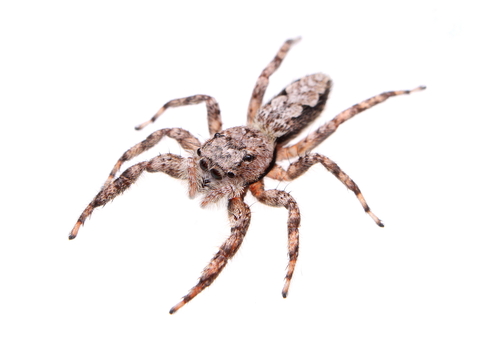
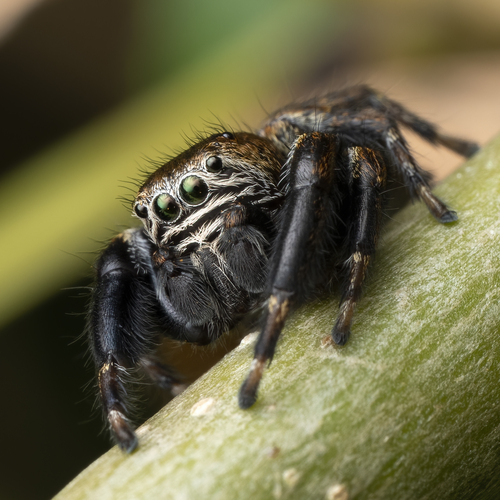
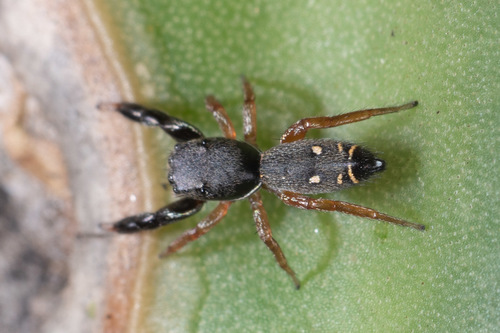
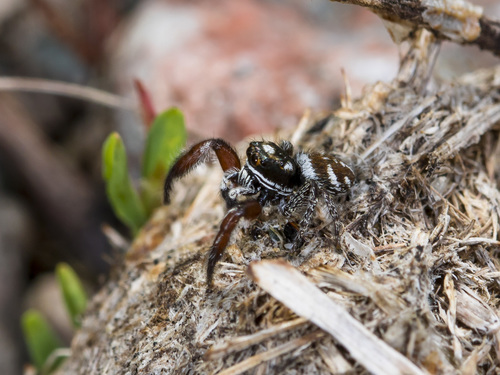
Pellenes nigrociliatus is a jumping spider species belonging to the genus Pellenes. It was originally described in 1875 under the name Attus nigrociliatus, and has been recognized by its current scientific name starting the year after its original description. Adult individuals range in total body length from 3.15 to 5.1 mm (0.124 to 0.201 in). The species is typically black in overall color and covered in white hairs. Its clypeus, the facial region below the eyes, extends outward beyond the eyes. A white or orange crescent-shaped marking is present on its eye field, and the top of its abdomen has a distinct pattern of broad white stripes that intersect in the center. Females are larger and generally darker in color than males.
Pellenes nigrociliatus has a broad distribution, found across Europe and Asia extending from the Canary Islands to China. More specifically, its range runs from the Canary Islands, through Turkey and Israel, across the Caucasus and Russia, to Central Asia and as far east as China. It is common throughout Central Asia, including the countries of Azerbaijan, Turkmenistan, Kyrgyzstan, Tajikistan and Uzbekistan. It is native to Europe, where it has been recorded across a wide span of countries including France, the Czech Republic, Poland, Romania and Ukraine. Within China, the species occurs in the regions of Xinjiang and Yunnan.
Pellenes nigrociliatus occupies a wide variety of dry habitats, including sandy slopes in chalky and rocky steppes, grasslands, sand dunes, and Miscanthus grass meadows. It is a thermophilic species that shows preference for sandy slopes in grasslands and sand dunes, and has also been recorded in chalky and rocky steppes and Miscanthus grass meadows. In Central Asia, it is common in broadleaf forests.
In Europe, males are most frequently encountered in May, while females are most commonly found toward the end of June and in July. This spider nests and overwinters inside empty snail shells, most commonly shells of the species Xerolenta obvia. Female spiders suspend these occupied snail shells from trees using braided silk threads 1 to 3 cm (0.39 to 1.18 in) long. When trees are not available, females may attach the shells to grasses, or to walls in areas with no vegetation. Females prefer to attach their shells to locations with more vegetation than males do. The spider builds a thick silk curtain or door to cover the shell entrance. Occupied snail shells often weigh five or more times as much as the spider itself. The shells provide shelter from attacks by ants, and females also use the shells to store their eggs.
The wider genus Pellenes is found across the Afrotropical, Holarctic and Indomalayan realms.